
Australian Shepherd puppies arrive with a particular set of wiring. They’re bred to work independently, read subtle environmental cues, and respond to pressure with either engagement or withdrawal. This means confidence in an Aussie pup isn’t built the same way it is in a Golden Retriever or a Lab. You can’t just throw them into social situations and expect them to bounce back cheerfully. Their confidence is more fragile, more conditional, and more dependent on how they interpret what’s happening around them.
Over the years, I’ve noticed that owners often confuse activity level with confidence. An Aussie puppy that’s running around, play-biting, and getting into everything can look confident. But that’s just puppyhood energy. Real confidence shows up differently – in how the pup handles novelty, responds to correction, and settles when uncertain. A genuinely confident Aussie puppy will investigate something new, check in with you, and move forward. A pup that’s just high-energy might panic, freeze, or become reactive when something unexpected happens.
The foundation for confidence starts before the puppy even arrives at your home. Breeders who handle litters early and expose them to varied stimuli – different surfaces, sounds, people – give puppies a head start. But that early work only matters if you continue it. The moment a puppy arrives with you, that window of critical socialization is still wide open, and it closes faster than most people realize. By sixteen weeks, the pup’s personality is largely formed. What you do in those first eight to twelve weeks shapes how they’ll respond to the world for years.
Exposure Without Pressure
The mistake I see most often is owners treating socialization like a checklist. They take the puppy to a dog park, a pet store, a busy street, and a friend’s house, then assume the pup is “socialized.” That’s not how it works. Exposure without context just creates memories – sometimes good ones, sometimes frightening ones. A puppy that gets rushed by an adult dog at the park doesn’t gain confidence; they learn that parks can be unpredictable and scary.
What actually builds confidence is controlled exposure. This means choosing environments where the puppy can observe something new without being forced to interact with it. A young Aussie pup sitting in your lap at an outdoor café, watching people and traffic, is learning far more than one being passed around to strangers. They’re learning that novel things exist, that they can be nearby, and that you’re a stable point of reference. That last part is crucial. The puppy needs to know they can look back at you and see that you’re calm and unworried.
I’ve found that the best confidence-building happens when you’re not trying. Take the puppy on errands. Let them experience different flooring – tile, gravel, wood, grass. Walk past construction sites. Drive different routes. These mundane exposures, repeated over weeks, teach the puppy that the world is large but manageable. They also teach the pup to trust your judgment about what’s safe, which is the foundation of confidence.
Consistency and Predictable Boundaries
Australian Shepherds are sensitive to inconsistency. More so than many breeds, they seem to notice when rules change or when your mood shifts. A puppy that gets scolded for jumping on Monday but gets excited play-wrestling on Tuesday becomes confused. That confusion erodes confidence because the puppy no longer knows what to expect from you or what behavior will produce a predictable outcome.
Confidence in a young Aussie comes partly from knowing where the lines are. This doesn’t mean being harsh or rigid. It means that when you say no, you mean it every time. When you say yes, the puppy knows what that looks like. When you’re training – whether it’s basic obedience or just household manners – the same request should produce the same expectation. A puppy that understands the rules feels more secure than one that’s guessing.
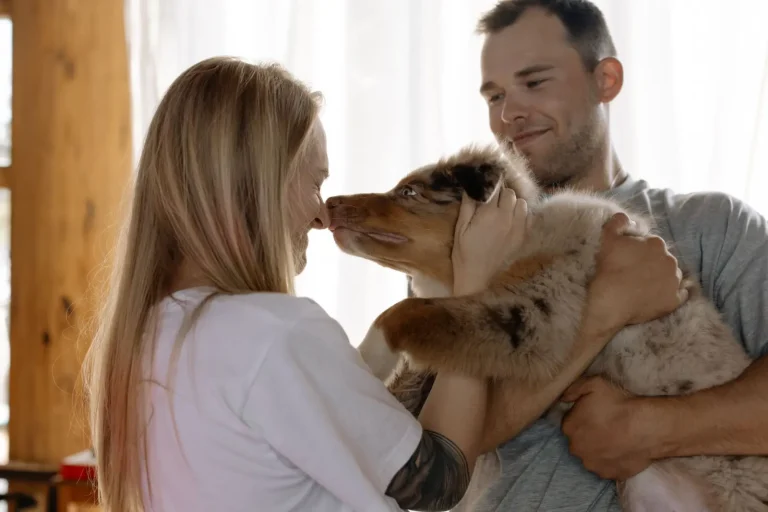
Handling is another area where consistency matters. Aussie puppies need to get used to being touched, examined, and moved around. But this should happen in a calm, matter-of-fact way. If you only handle the puppy when you’re excited or playing, they’ll anticipate excitement every time your hands come near them. If you handle them during quiet moments – checking their ears, looking at their paws, brushing them – they learn that handling is routine and not a precursor to something stimulating.
Recognizing Fear and Responding Appropriately
Not every puppy is naturally bold. Some Aussie puppies are cautious from the start, and that’s not a flaw. It’s their temperament. The problem arises when owners either push a cautious puppy too hard or, conversely, coddle them and reinforce fearfulness.
When a puppy shows hesitation – maybe they pause before stepping on a new surface or they startle at a noise – the instinct is often to reassure them verbally. “It’s okay, buddy. Don’t be scared.” This actually works against confidence. What the puppy hears is that you think there’s something to be afraid of. Instead, I’ve found it’s more effective to simply wait. Give the puppy a moment to process. If they’re not in danger, don’t intervene. Many puppies will investigate once they realize nothing bad happened. If they don’t, move on without making it a big deal. You can try again another time.
There’s a difference between a puppy that’s genuinely frightened and one that’s just being cautious. A truly frightened puppy will show physical signs – lowered body, tucked tail, avoidance. A cautious puppy is just hesitant. With a cautious pup, patience and repeated exposure usually work. With a frightened pup, you need to back up and create more distance or a less intense version of the stimulus. Pushing through fear doesn’t build confidence; it builds anxiety.
Play and Appropriate Challenge
Play is often overlooked as a confidence builder, but it’s significant. The right kind of play – not overstimulation, not rough wrestling, but interactive play where the puppy can succeed – teaches them about their own capabilities. A puppy that retrieves a toy, plays tug-of-war within reasonable limits, or plays chase learns that they can affect their environment and that play has rules they can follow.
Training, too, is a form of play for an Aussie. These dogs want to work and to please. Short, successful training sessions build confidence more effectively than long ones where the puppy gets frustrated. If a puppy learns to sit and gets praised for it, that’s a small success. Repeated small successes compound into genuine confidence.
The key is appropriate challenge. A task that’s too easy doesn’t teach anything. A task that’s too hard frustrates the puppy and can make them shut down. The sweet spot is something the puppy can figure out with a little effort and your guidance. That’s where learning and confidence happen simultaneously.
What I’ve observed over time is that confident Aussie puppies aren’t the ones that were forced into every social situation or trained with the most intensity. They’re the ones whose owners stayed calm, remained consistent, and gave them space to figure things out. Confidence in this breed seems to come from trust – the puppy’s trust that you know what you’re doing and that the world, while full of novelty, isn’t dangerous. That takes time to build, but once it’s there, it tends to stick.