

Tire the legs. Engage the mind.
Australian Shepherds were developed to notice, think, respond and work. Mental enrichment gives that active brain something useful to do — without turning every day into an endless mission to physically exhaust your dog.
Intelligence needs somewhere to go.
Movement across the street. A door opening. The routine before a walk. Where you left the toy. Which cupboard contains food. What usually happens after you pick up your keys.
That awareness and capacity to learn are part of what makes Aussies so rewarding to live and work with. They also mean that simply providing physical exercise may leave an important part of the dog's needs unanswered.
Mental enrichment creates opportunities to sniff, search, discriminate, solve problems, learn skills, make appropriate choices and engage with the environment.
When “more exercise” isn't the whole answer.
Restlessness and unwanted behaviour can have many causes, so enrichment is not a universal diagnosis. But a lifestyle built almost entirely around physical output can miss the way an Aussie naturally uses its brain.
Always “on”
The dog constantly searches for the next activity and struggles to disengage even after substantial physical exercise.
Self-employed
When meaningful activities are absent, an intelligent dog may invent projects you never intended to commission.
Restlessness
Pacing, repeatedly requesting interaction or difficulty settling may suggest that the daily rhythm needs examining.
Repetitive routines
The same high-intensity activity every day may build physical fitness without providing much novelty or cognitive variety.
You cannot always outrun an Australian Shepherd.
A common response to an energetic Aussie is simple: add more exercise. Longer walks. More running. More fetch. More intensity.
Physical activity is important, but continually increasing it can create an increasingly fit dog who still has not learned how to settle or engage their brain in other ways.
Enrichment broadens the picture. A slow sniffing walk can serve a different purpose from a fast run. Ten minutes learning a new skill can create a different experience from ten minutes chasing a ball.
A good life includes movement, thinking, exploration, social connection and genuine rest.
Enrichment is bigger than puzzle toys.
You do not need a cupboard full of specialised equipment. Many of the richest activities use ordinary food, environments, movement, interaction and opportunities to make choices.
Sniffing & scent
Searching with the nose turns an ordinary environment into information and gives the dog an active role in exploration.
Problem solving
Appropriate puzzles and search tasks allow the Aussie to test ideas, make choices and discover how to reach a goal.
Training
New behaviours, discrimination tasks and practical skills create structured opportunities to think with you.
Exploration
New routes, surfaces, environments and opportunities to observe can make an ordinary outing cognitively rich.
Interactive play
Play with rules, communication and shared attention can become both enrichment and relationship-building.
Rest & settling
A dog who can disengage and recover has a skill just as valuable as the dog who can enthusiastically work.
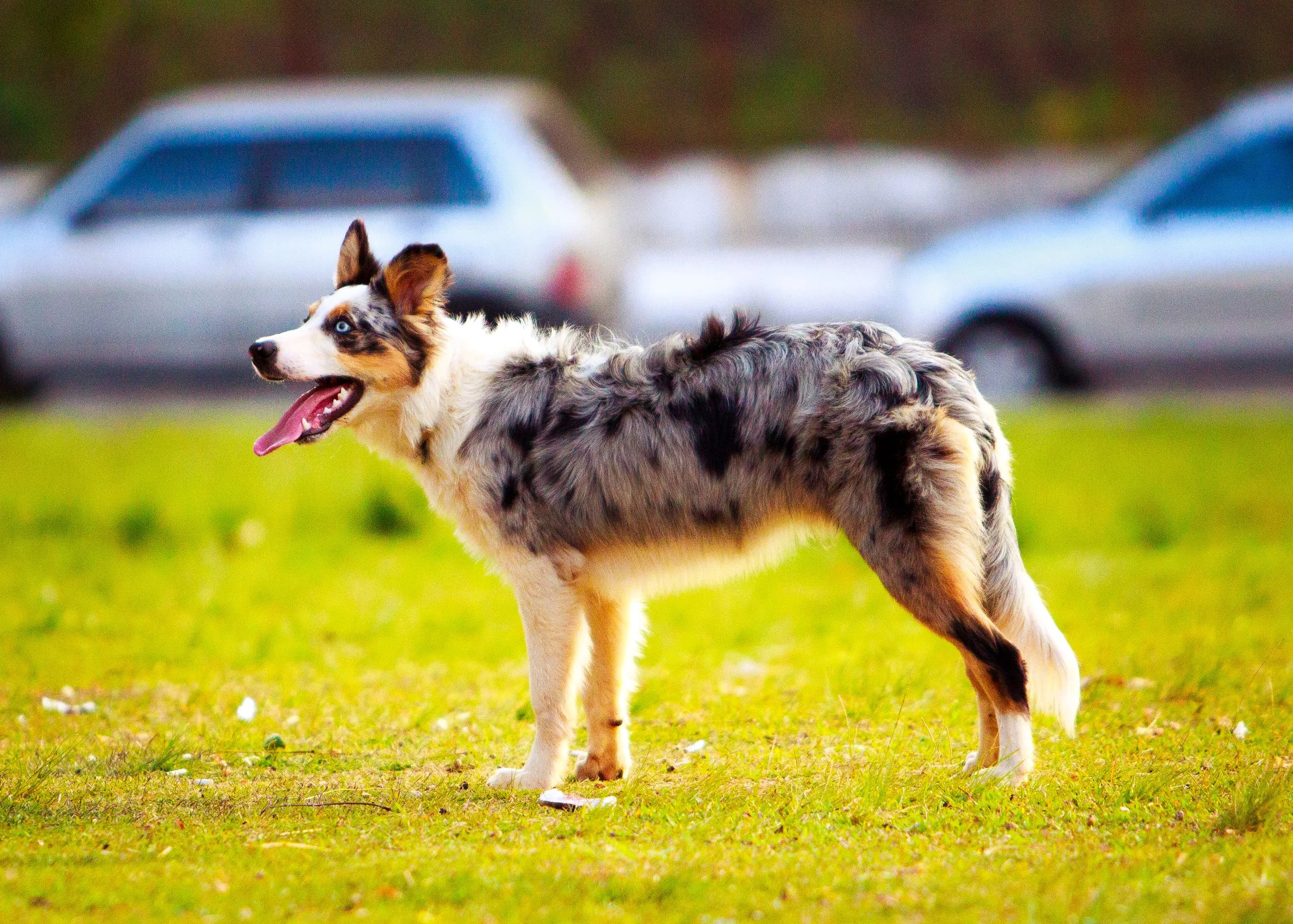
Let the nose do some of the work.
Humans often measure a walk in kilometres, minutes or pace. Dogs can experience the same route as an enormous field of scent information.
Giving your Aussie appropriate opportunities to stop, investigate and follow smells changes the purpose of the outing. The dog is no longer simply moving beside you; they are actively processing the environment.
You can also bring scent work home. Scatter food in grass, hide rewards around a room or teach your dog to search for a particular object.
Start easy enough that the dog understands the game. Difficulty should grow with skill rather than frustration.
Four scent games. Almost no equipment.
Scatter feeding
Scatter part of a meal across an appropriate grassy area and allow your Aussie to search rather than receiving every piece of food from a bowl.
Find it
Begin by placing a reward where your dog can easily locate it, then gradually increase the search challenge as the concept becomes familiar.
Which box?
Place several suitable boxes on the floor and hide food in one or more. Let your dog investigate and discover where the reward is.
The sniff walk
Choose an appropriate outing where pace is secondary and give your dog more freedom to investigate safe smells along the route.
Give the answer less often.
Intelligent dogs can become very good at looking to humans for instructions. Training requires communication, but enrichment can also create situations where the dog gets to investigate and solve an appropriate problem independently.
Food puzzles are one option. So are simple household setups: a treat loosely wrapped in safe paper, food hidden beneath suitable objects or a cardboard search box assembled for supervised use.
Watch the level of difficulty. A useful challenge creates engagement. An impossible task creates frustration.
If your Aussie gives up immediately, make the problem easier. If they solve it in two seconds every time, add a small layer of complexity.
The sweet spot is a challenge your dog can solve with thought, exploration and a little effort.
Five focused minutes can matter.
Enrichment does not have to occupy an afternoon. Short learning sessions can turn an ordinary part of the day into meaningful cognitive work.
Teach something the brain has to process.
Australian Shepherds often enjoy learning because training combines information, reinforcement and interaction with their person.
Practical behaviours are excellent enrichment. Recall, loose-lead walking, settling, cooperative handling and impulse control all require the dog to process information and make choices.
You can also teach tricks, object names, directional cues, targeting, retrieving particular items or discrimination between different signals.
Keep sessions short enough that enthusiasm survives the session. More repetitions are not automatically better repetitions.
Explore Australian Shepherd trainingFood can become an activity.
If your dog is already eating the food, using an appropriate portion of it for enrichment can add activity without automatically adding extra food to the day.
Scatter
Turn part of a meal into a search across a safe area instead of placing everything in one location.
Search
Hide food in easy locations and gradually develop the dog's ability to search a room or suitable outdoor space.
Puzzle
Appropriate food puzzles can add manipulation and problem solving to something the dog already values.
Train
Use part of the dog's normal food allocation during short training sessions when the food is suitable and motivating.
Sometimes the enrichment is simply somewhere different.
Novelty does not require an elaborate adventure. A different walking route, a quiet trail, a new surface or time observing an unfamiliar environment can give your Aussie new information to process.
Allow exploration rather than turning every outing into structured heelwork. There is value in training, and there is also value in giving a dog appropriate agency to investigate.
Match environments to the individual dog. A crowded event may be stimulating but not enriching for a dog who finds the situation overwhelming.
The best environment is not necessarily the busiest one. It is one your dog can engage with successfully.
Explore Aussie activities
Enrichment includes learning when nothing is happening.
Owners of active breeds can accidentally create a lifestyle in which the dog expects entertainment whenever they are awake.
Walk. Training. Puzzle. Fetch. Another walk. Another game. Every moment becomes a cue for activity.
But adult life also contains ordinary afternoons, conversations, work, meals and evenings when the dog needs to coexist without becoming the centre of an activity programme.
Reward calm behaviour. Create predictable periods of rest. Provide appropriate resting places. Avoid responding to every request for action by immediately inventing a new game.
A capable Australian Shepherd should not only know how to engage. They should gradually learn how to disengage.
Think in rhythms, not entertainment schedules.
There is no universal enrichment timetable for every Australian Shepherd. Age, health, temperament, training history and lifestyle all matter. A useful framework is variety followed by recovery.
Explore
A walk with opportunities to sniff, move, check in and experience the environment rather than simply cover distance.
Think
A short training session, scent search or simple problem-solving activity can provide focused cognitive engagement.
Live
Ordinary household time matters too. The dog does not need a structured project every hour of the day.
Settle
Lower intensity and reinforce the ability to relax as the household moves into a quieter part of the day.
A puppy doesn't need the workload of an adult Aussie.
Young Australian Shepherds are learning constantly. A trip into the garden, a new surface, a few minutes of handling practice or learning to follow a food lure may already contain a significant amount of new information.
Keep enrichment age-appropriate. Make tasks solvable. Supervise materials the puppy might chew or swallow and avoid assuming that more stimulation is always beneficial.
Puppies also need substantial rest. An overtired puppy can look like a puppy who needs more activity — racing, biting, grabbing and struggling to settle.
The skill is learning to distinguish between a puppy who needs an outlet and one who needs help switching off.
Australian Shepherd puppy first yearEnrichment can become too much.
Constant novelty, frustration and high arousal are not the goal. Watch what the activity actually does to your dog rather than assuming every “brain game” is automatically beneficial.
If the dog repeatedly cannot solve a task and becomes increasingly agitated, reduce the difficulty rather than insisting they persist.
Some games produce excitement rather than calm engagement. That is not necessarily bad, but it should fit the context and dog.
An activity that leaves your Aussie demanding more and unable to settle may need to be balanced with lower-arousal work.
Enrichment should improve everyday life, not make normal life impossible unless someone is constantly entertaining the dog.
Seven days. Seven different ways to use the brain.
Variety can be simple. You do not need seven elaborate activities every day. Rotate small opportunities through an ordinary week.
A slower walk with extra time to investigate safe scents.
A short session introducing or refining a useful behaviour.
Hide part of a meal and let your Aussie use their nose.
Take a different route or visit an appropriate new environment.
Offer a manageable puzzle or supervised search-box activity.
Share an interactive game with communication built into it.
Keep things simple and give recovery a place in the week.
Give the mind work. Give the dog space to rest.
Living well with an Australian Shepherd is not about filling every waking minute with activity. It is about creating a life with enough movement, learning, exploration and connection to satisfy an intelligent working dog — while teaching that brilliant brain that quiet moments belong in the picture too.
Explore life with an Aussie