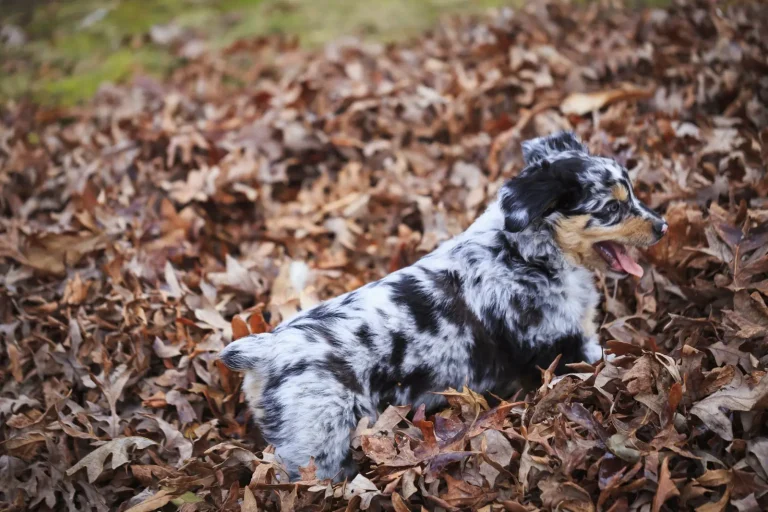


Australian Shepherds show up to obedience trials with an obvious advantage: they were built for work that requires attention, responsiveness, and the ability to read subtle signals. I’ve watched hundreds of them move through obedience rings over the years, and the pattern is consistent. They tend to arrive already half-trained by their genetics. The breed’s herding background means they naturally orient to handlers, they move with precision, and they rarely need to be convinced that paying attention matters. But that same intensity that makes them naturals in the sport also creates a specific set of problems that don’t show up as obviously in other breeds.
The first real obstacle most handlers encounter isn’t about teaching obedience – it’s about managing the dog’s own expectations. Australian Shepherds are not passive learners. They’re actively trying to figure out what you want, which sounds ideal until you realize that a dog this engaged will also try to anticipate your commands, second-guess your timing, and sometimes correct themselves before you’ve even asked. I’ve seen handlers struggle with what looks like disobedience when it’s actually the opposite: the dog is so locked in that it’s working three steps ahead. Managing that forward momentum without crushing the drive is where the real work begins.
The Energy Problem That Isn’t About Exercise
People often assume that obedience problems in Australian Shepherds stem from insufficient physical exercise. This is partially true but mostly misleading. Yes, these dogs need to move. But I’ve seen extremely fit Australian Shepherds fail in the obedience ring because they were mentally restless, not physically tired. The breed has a particular kind of mental intensity that doesn’t resolve through a long run or a fetch session. It resolves through structured, focused work that gives the dog a clear job and clear feedback.
What this means in practice is that an Australian Shepherd preparing for obedience competition needs regular training sessions, not just exercise time. These should be short – fifteen to twenty minutes is often more effective than an hour – and they should be consistent. The dog learns to expect the structure, to anticipate the focus, and to settle into the work. Without this, even a tired Australian Shepherd can develop what looks like hyperactivity in the ring: pacing, anticipating, breaking sits, forging on heels. It’s not misbehavior. It’s a dog that hasn’t learned how to be calm within the context of work.
Precision and the Problem of Too Much Responsiveness
Australian Shepherds tend to excel at the technical aspects of obedience. Sits, downs, stays, recalls – these come naturally to a breed that evolved to respond to minute hand signals and whistle commands. The heel is often where handlers see the real payoff. An Australian Shepherd with proper foundation work will move in tight, clean heels with minimal guidance. But this strength creates a hidden liability.
Because they’re so responsive, Australian Shepherds can become overly dependent on handler cues. They’ll watch your feet, your hands, your body angle, your breathing pattern – anything that might signal a change. In lower-level obedience classes, this looks like attentiveness. In higher-level competition, it becomes a problem. The dog needs to hold positions and execute commands based on clear signals, not on constant micro-corrections. I’ve seen handlers inadvertently train their Australian Shepherds to be so attuned that the dog is essentially reading body language instead of responding to actual commands. When the handler tightens up in the ring – which everyone does – the dog feels that tension and reacts to it, often by breaking position or anticipating the next move.
Consistency and the Handler Variable
Australian Shepherds are famously sensitive to handler mood and energy. This is often framed as an advantage, and it can be. But in obedience sports, it becomes a significant variable. The dog will perform differently depending on whether the handler is confident, anxious, distracted, or frustrated. Over years of watching handlers work with this breed, I’ve noticed that Australian Shepherds don’t forgive inconsistency the way some other breeds do. A Golden Retriever might shrug off a slightly late correction or an unclear command. An Australian Shepherd will notice the inconsistency and adjust its behavior accordingly, which often looks like the dog becoming unreliable or stubborn when the real issue is that the handler’s communication has shifted.
This means that preparation for obedience competition with an Australian Shepherd requires the handler to develop real consistency in timing, tone, and physical cues. It’s not enough to know what you want the dog to do. You have to be able to communicate it the same way every single time. The breed will expose any variation in your technique, which is valuable information but also demanding.
Competition Environments and Novelty
Australian Shepherds often handle novel environments well – they’re curious and adaptive by nature. But there’s a difference between handling novelty and performing reliably in it. I’ve watched dogs that train beautifully at home become scattered or overstimulated at a trial venue. The Australian Shepherd’s natural tendency to scan the environment and assess threats or opportunities can work against precision work in a busy competition setting.
The solution isn’t to suppress this trait. It’s to train in varied environments early and often, and to teach the dog that the obedience ring is a specific context with specific rules. Australian Shepherds learn contextual behavior quickly – they understand that different settings mean different expectations. But this has to be taught deliberately. A dog that only trains in a quiet backyard or a familiar training facility will struggle when asked to perform in a ring full of other dogs, unfamiliar people, and distracting sounds.
Successful handlers I’ve worked with typically introduce their Australian Shepherds to trial-like conditions months before entering actual competition. They practice in different locations, with different people present, with distractions at varying distances. The dog learns that the obedience work is the constant, regardless of what’s happening around it.
Australian Shepherds belong in obedience sports. Their natural aptitude for the work is real, and their ability to execute precise commands is often exceptional. But they require handlers who understand that the breed’s strengths – sensitivity, responsiveness, intelligence, and drive – are also the factors that demand the most careful management. The dogs that excel in competition are typically those whose handlers have spent time not just training the obedience behaviors, but training themselves to be consistent, clear, and calm. That’s where the real work happens.