
Australian Shepherd puppies arrive with a lot of natural caution built in. After working with dozens of them over the years, I’ve noticed that this breed doesn’t automatically trust new people, places, or situations the way some other breeds do. They’re observant and selective by nature, which is useful for herding work but can become a liability if their early months aren’t handled thoughtfully. Socialization isn’t about forcing them to be outgoing – it’s about building their confidence so they can make calm, measured decisions in unfamiliar circumstances.
The critical window runs roughly from three weeks to sixteen weeks, though the real learning continues well into the first year. During those early months, a puppy’s brain is absorbing information at a rate that won’t happen again. What they experience – or don’t experience – during this time shapes how they’ll respond to the world as adults. I’ve seen puppies that missed early exposure struggle with basic outings at two years old, still hesitant around sounds, surfaces, or people they never encountered as youngsters.
The mistake I see most often is confusing socialization with entertainment. Owners will take their puppy to a busy dog park or a crowded market thinking exposure equals socialization, but that’s not how it works. An overwhelmed puppy learns to be anxious, not confident. With Australian Shepherds especially, flooding them with stimulation tends to backfire. They need controlled, graduated exposure where they can observe and adjust at their own pace.
Building Exposure Without Overwhelming
The approach that consistently produces calm, adaptable dogs involves short, low-pressure encounters. A fifteen-minute walk down a quiet street where the puppy hears distant traffic is more valuable than an hour at a crowded park. They’re learning that new sounds exist and that nothing bad happens when they do. Over weeks, you gradually increase the intensity – busier streets, more people at a distance, different surfaces underfoot.
Surfaces matter more than people realize. Puppies need to walk on grass, gravel, concrete, wood, tile, and metal grating. They need to experience wet ground, uneven terrain, and slopes. An Australian Shepherd that’s only ever walked on flat grass will be genuinely anxious crossing a parking lot or walking on a bridge. I’ve worked with dogs that were nearly two years old before they could confidently walk on certain surfaces because they’d missed that early exposure.
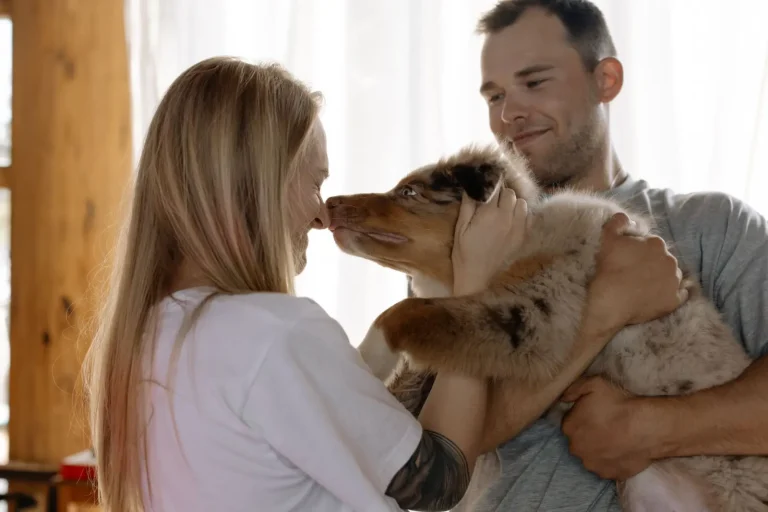
People interactions should be similarly measured. Instead of having your puppy meet a crowd, arrange brief meetings with individual people – a neighbor, a friend, someone at the vet’s office. Let the puppy approach at their own speed. If they’re hesitant, that’s fine. Forcing them into a stranger’s arms teaches them that unfamiliar people are something to be nervous about. The goal is for them to learn that new people simply exist and are generally unremarkable.
Handling and Restraint as Part of Socialization
Australian Shepherds need to be comfortable with physical handling because they’ll encounter veterinary exams, grooming, and occasional restraint throughout their lives. Many owners skip this or do it inconsistently, then wonder why their dog becomes defensive at the vet’s office. Handling should start early and be routine – touching their paws, ears, mouth, and rear end in a casual, matter-of-fact way while they’re eating or relaxed. Make it normal, not something that happens only when something uncomfortable is about to occur.
Grooming exposure is particularly relevant for this breed. Their coat requires regular brushing, and many Australian Shepherds develop serious anxiety around grooming because they weren’t desensitized to the sensation of being handled with tools. Start with a soft brush on a calm puppy, keep sessions brief, and reward the behavior. By the time they’re six months old, a well-socialized Aussie should accept grooming without tension.
Noise Sensitivity and Environmental Sounds
This breed tends toward noise sensitivity more than many others. A puppy that hasn’t heard fireworks, thunderstorms, vacuum cleaners, or power tools during their critical window often develops lasting anxiety around those sounds. I’ve seen adult dogs that can’t function during storm season or around construction noise because they missed early exposure. The solution isn’t to hide from loud sounds – it’s to introduce them gradually and at low volumes, paired with something positive like treats or play.
Recording apps that play environmental sounds are useful, but they’re not a substitute for real-world exposure. A puppy needs to hear an actual vacuum cleaner at a distance, then closer over time. They need to experience the real vibrations and unpredictability of actual sounds, not a controlled audio file. Start in another room and gradually move closer as the puppy becomes indifferent to the noise.
Other Dogs and Pack Dynamics
Exposure to other dogs is necessary, but the quality of that exposure matters enormously. A puppy meeting an older, calm dog in a controlled setting teaches them appropriate dog communication. A chaotic interaction with an aggressive dog or a pack of rowdy puppies can create lasting wariness or defensive behavior. I typically recommend introducing puppies to one or two well-mannered adult dogs rather than throwing them into group situations early on.
If you have another dog at home, that’s valuable, but it’s not enough on its own. Puppies need to meet dogs of different sizes, ages, and temperaments so they learn that variation is normal. An Aussie that’s only ever known one other dog might react with suspicion or anxiety when encountering different dogs later.
What Gets Overlooked
The things that don’t seem important often matter most. Puppies need exposure to children, but specifically to children behaving like children – running, playing, making sudden movements and noise. They need to experience being startled, approached quickly, and touched unpredictably in a safe context. Without this, many Australian Shepherds become herding-focused or anxious around kids because they never learned to interpret those behaviors as normal.
Vet visits are socialization opportunities, not just medical appointments. Make them frequent and low-stakes in the early months. Visit just to say hello, get weighed, and leave. Let the puppy associate the vet’s office with nothing bad happening. This pays dividends when they actually need medical care and don’t arrive at the clinic already anxious.
By around five or six months, most of the foundational socialization has either happened or hasn’t. The window doesn’t slam shut completely, but recovery from missed early exposure takes significantly more time and effort. I’ve found that puppies socialized thoughtfully during those first months develop into adults that handle novelty with genuine calm rather than forced bravery. They’re not necessarily the most outgoing dogs, but they’re confident in their own assessment of situations, which is exactly what this breed should be.