

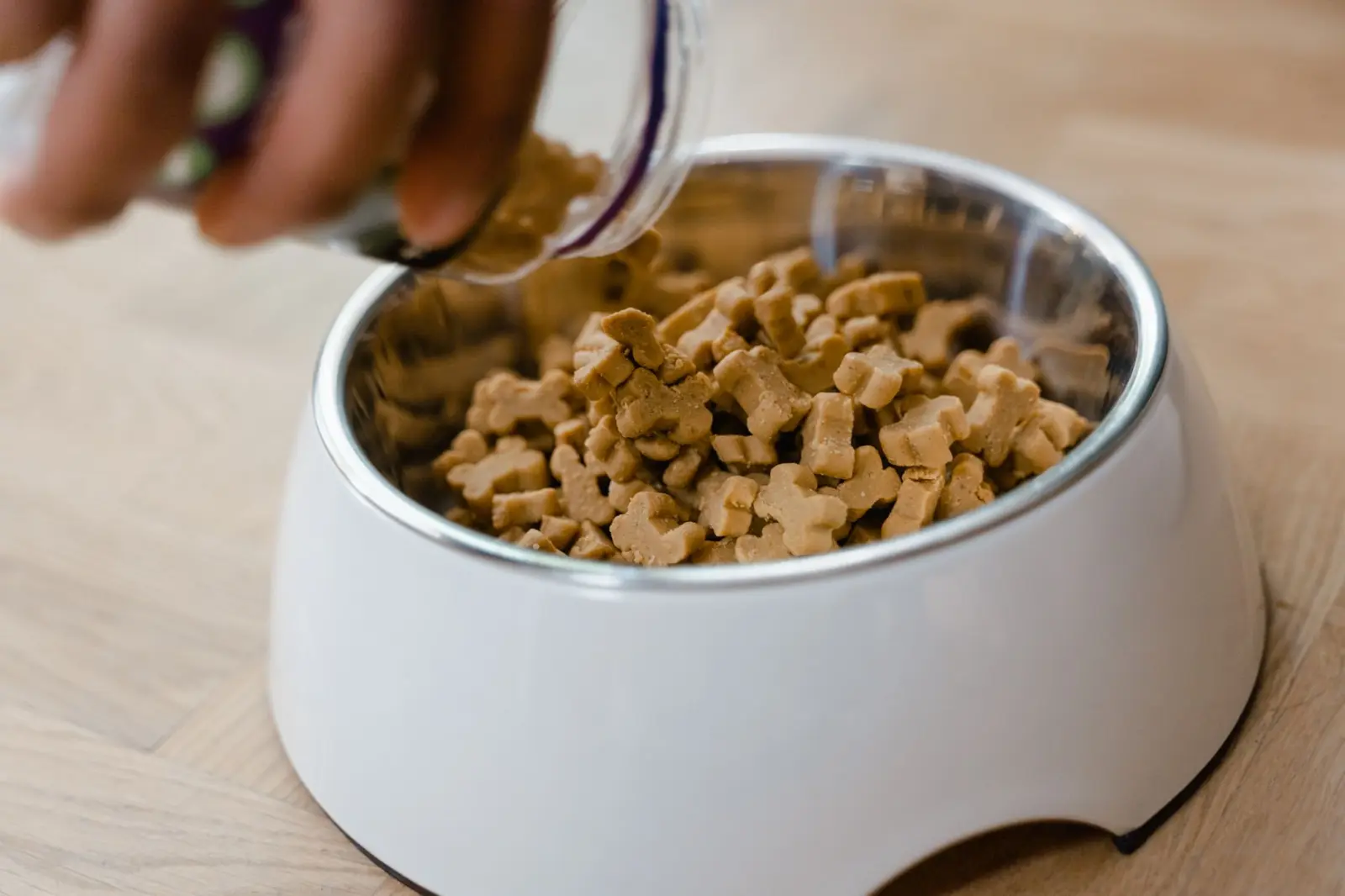
Australian Shepherd puppies grow quickly, and their feeding needs shift noticeably as they move through their first year. I’ve worked with enough of these litters to recognize that there’s no single answer that fits every pup – their individual metabolism, activity level, and frame size matter as much as their age. That said, there are clear patterns in what works and what tends to create problems down the line.
The foundation is understanding that Australian Shepherds are a medium-to-large breed with moderate to high energy. They’re not giant breeds like Great Danes or Saint Bernards, but they’re not small dogs either. This matters because growth rate affects how you structure meals. A puppy that grows too quickly can develop joint stress, particularly in the hips and elbows. Too slow, and you’re leaving development on the table. The sweet spot is steady, controlled growth.
Eight to Twelve Weeks: Frequent Small Meals
At eight weeks, when most puppies arrive in their new homes, their stomachs are small and their metabolism is fast. Four meals a day is standard at this age, and I’ve found it’s not just a rule – it’s necessary. A puppy this young can’t hold much food at once, and their blood sugar drops quickly between meals. You’re looking at roughly 25 to 30 percent of their daily caloric intake per meal, spaced evenly through the day.
The practical reality is that four meals means someone needs to be home or have a reliable feeding schedule. If that’s not possible, three meals can work, but you’ll likely notice the puppy is hungrier between feedings and may be more prone to mouthing or minor behavioral issues driven by that hunger. I’ve seen owners try to compress four meals into three by increasing portion size, and it usually backfires – the puppy either struggles to digest the larger amount or develops an inconsistent stool pattern.
Portion size at this stage depends on the puppy’s weight and the food’s caloric density. Most quality puppy formulas recommend between 1 and 1.5 cups per day total, divided into four meals. That’s roughly a quarter cup per feeding for an average eight-week-old. It’s not much, but it’s enough. The puppy’s growth rate at this age is steep – they’re doubling or tripling their birth weight within weeks – so the nutrition is concentrated.
Three to Four Months: Consolidating to Three Meals
By twelve weeks, most Australian Shepherd puppies are ready to drop to three meals a day. Their stomachs have grown, and their digestive systems are more efficient. The transition is usually smooth if you do it gradually – mixing the old four-meal schedule with the new three-meal schedule over a week or so. What I typically see is that puppies naturally start leaving food in their bowl at one of the four meals, which is a clear signal they’re ready to consolidate.
At this point, you’re feeding roughly 30 to 35 percent of daily calories per meal. The total daily intake is climbing because the puppy is larger and growing faster. By sixteen weeks, an average Australian Shepherd puppy might be eating 1.5 to 2 cups per day total, depending on the individual and the food formula. Some puppies are naturally leaner and eat less; others are stockier and need more. You adjust based on what you see in their body condition, not just a chart.
This is also the stage where I start paying closer attention to stool consistency and energy levels. A puppy that’s getting the right amount of food will have firm, consistent stools and steady energy throughout the day. If stools are loose or the puppy seems lethargic, something’s off – either the amount is wrong, the food isn’t sitting well, or there’s a health issue worth checking with a vet. I’ve found that most feeding problems at this age are actually portion-related, not food-related.
Four to Six Months: The Growth Acceleration Phase
Between four and six months, Australian Shepherd puppies hit a growth acceleration. Their frame is lengthening, their muscle is developing, and their caloric needs jump noticeably. This is when owners often underfeed without realizing it – they’re still thinking of the puppy as small, but the puppy’s needs have changed significantly. By six months, a healthy Australian Shepherd puppy can weigh 30 to 40 pounds, depending on sex and genetics.
At this stage, three meals a day is still appropriate, but the portions are larger. Total daily intake might be 2 to 2.5 cups, sometimes more for larger individuals. The key is that you’re still dividing it into three meals rather than jumping straight to two. The puppy’s digestive system is more mature, but three meals keeps the nutrient load more manageable and helps prevent bloat, which is a real risk in growing large-breed dogs.
I watch carefully for signs of too-rapid growth during this phase. A puppy that’s getting too many calories or too much protein can grow so fast that their bones and joints can’t keep up structurally. This doesn’t always show up immediately, but it can create problems later – lameness, joint instability, or early arthritis. On the flip side, underfeeding during this critical growth window means missing out on bone density and muscle development that’s hard to make up later. It’s a narrow window, and the best gauge is the puppy’s body condition and your vet’s assessment at regular check-ups.
Six to Twelve Months: Transition to Adult Feeding
By six months, most Australian Shepherd puppies are ready to transition from three meals to two meals a day. This is a gradual shift, not an abrupt one. I typically recommend moving one of the three meals to a slightly larger portion in one of the remaining two meals over a week or two, letting the puppy adjust. Two meals a day is sustainable long-term and aligns with how most adult dogs are fed.
From six months onward, total daily intake continues to climb slightly, but the rate of growth is slowing compared to the first six months. By nine months, an Australian Shepherd might be eating 2 to 3 cups per day, depending on size and metabolism. By twelve months, they’re approaching their adult size, though they’ll continue filling out and gaining muscle until around eighteen months. The difference between a six-month-old and a twelve-month-old is significant in terms of frame, but the feeding schedule is now essentially adult.
The transition from puppy food to adult food typically happens around twelve months, though some owners stretch it to eighteen months with larger-framed puppies. Puppy formulas are higher in calories and protein to support growth, while adult formulas are balanced for maintenance. The switch isn’t urgent at twelve months, but it’s worth planning. I’ve found that most Australian Shepherds transition smoothly to adult food without digestive upset if you mix the old and new food over a week.
Variables That Shift Everything
Individual metabolism varies widely, even within the same litter. Some puppies are naturally lean and seem to burn calories constantly; others are stockier and gain weight more easily. Activity level matters enormously. A puppy that’s being trained, playing regularly, or living with other dogs will have higher caloric needs than one that’s mostly resting. I’ve also noticed that puppies from working lines tend to have faster metabolisms than those from show lines, though that’s not a hard rule.
The quality and type of food also affects how much you need to feed. A nutrient-dense, high-quality puppy formula means smaller portions than a lower-quality food with more fillers. This is one reason I always recommend checking the feeding guidelines on your specific food and then adjusting based on what you observe in your puppy, rather than following a generic chart. What works for one Australian Shepherd puppy on one food might not work for another on a different food.
Health factors can shift feeding needs as well. A puppy recovering from illness or injury might need more calories temporarily. Conversely, a puppy with a sensitive stomach might do better on smaller, more frequent meals even beyond the typical age for consolidation. These are situations where you work with your vet to adjust, not just follow a standard schedule.
The reality of raising an Australian Shepherd puppy is that feeding is as much about observation as it is about following a schedule. You’re watching body condition, energy levels, stool quality, and growth rate. The schedule – four meals at eight weeks, three meals at twelve weeks, two meals at six months – is a framework, not a law. Most puppies fit that framework reasonably well, but the best owners are the ones who notice when their individual puppy needs something slightly different and adjust accordingly.