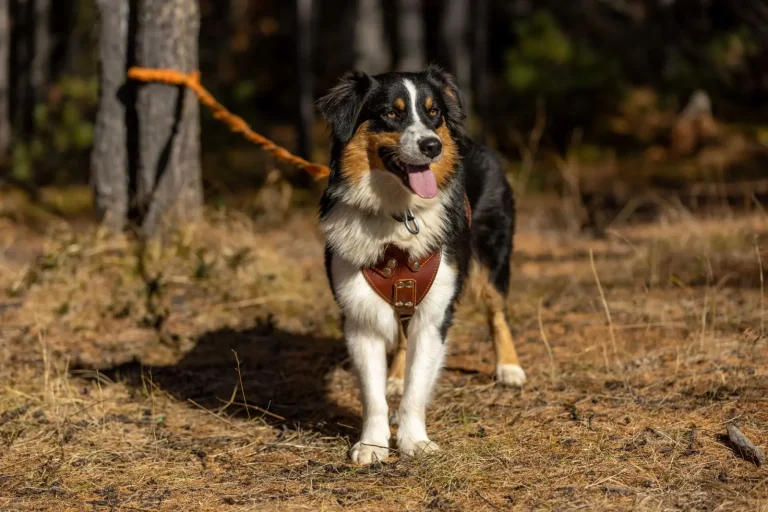


Australian Shepherds are driven by motion and change. After years of working with this breed, I’ve noticed that their distraction issues rarely stem from stubbornness or lack of intelligence. Instead, they’re wired to notice everything – a trait that made them effective herding dogs and now makes them prone to fixating on movement, other animals, or sudden sounds. The challenge isn’t teaching them what “sit” means. It’s teaching them to choose to sit when a squirrel bolts across the yard or another dog appears fifty feet away.
Most owners encounter this problem gradually. A young Aussie might respond perfectly to commands in a quiet living room, then completely ignore you at the dog park. This isn’t a training failure. It’s a threshold issue. The dog’s environment has changed so dramatically that the familiar cue has become background noise. Understanding this distinction changes how you approach the problem.
The real work happens in what I call the “gray zone” – situations that are moderately distracting but not overwhelming. This is where most training actually takes root. A dog that can hold a down-stay while you’re in the kitchen is not the same dog that can hold it while someone walks past the window. Building that bridge requires patience and a clear sense of what your specific dog finds genuinely difficult.
Starting with Threshold Awareness
Before you can train through distractions, you need to know what actually distracts your dog. This sounds obvious, but many owners skip this step and jump straight into training scenarios that are too hard. I’ve seen people try to work on recall in a busy park when their dog hasn’t yet proven reliable recall in a moderately stimulating environment like a quiet residential street.
Spend time observing your dog in different settings without trying to train anything. Notice what makes them pause, what makes their ears perk up, what causes them to lose focus entirely. Some Aussies are primarily motion-triggered. Others fixate on other dogs. A few are sound-sensitive. These individual patterns matter enormously when you’re designing a training progression.
Once you’ve identified what genuinely captures your dog’s attention, you can build a hierarchy. A dog that’s 70% focused in a mildly distracting environment is a good starting point for distraction training. A dog that’s already at 30% focus is too overwhelmed, and you’ll just reinforce the habit of ignoring you.
The Importance of Solid Foundation Work
I rarely see an Aussie with distraction problems who also has bulletproof obedience in quiet settings. The two are connected. If your dog’s sit is inconsistent when you’re alone in your backyard, it will absolutely fall apart when there’s stimulation present. This isn’t a distraction issue yet – it’s a foundation issue masquerading as one.
Before moving to distracting environments, spend time ensuring that basic cues are automatic in low-distraction settings. This means practicing in the same location repeatedly until the behavior requires almost no thought from the dog. With Aussies, this usually takes longer than owners expect because they’re intelligent enough to recognize patterns and get bored. Vary your timing, your position, and your rewards, but keep the environment itself calm.
An Australian Shepherd with a solid foundation – one where sit, down, and stay are genuinely automatic – will have a much easier time accessing those behaviors when distractions appear. The dog isn’t learning the behavior for the first time in a challenging environment. They’re remembering something they already know deeply.
Gradual Environment Changes
The actual progression into distracting environments should be incremental. Move from your quiet backyard to a less busy area of the neighborhood. Then to a busier area. Then to a location where other dogs are present but at a distance. Each step should feel manageable for your dog, not like a sudden leap in difficulty.
What I’ve learned is that Aussies often need more repetitions in each new environment than owners realize. A dog might nail recalls in your backyard for weeks, then struggle for the first few sessions in a new location. This isn’t regression. It’s the dog learning that the rules still apply in this different context. Most owners need to spend at least 5 to 10 sessions in a new environment before moving to something more challenging.
During these sessions, keep distractions somewhat controlled. If you’re working on focus in a park, choose a time when it’s less busy. You’re not trying to train in maximum chaos. You’re building confidence and reliability in moderately stimulating conditions so that when real chaos happens, the dog has a foundation to fall back on.
Reward Timing and Value
The reward system shifts when you introduce distractions. In a quiet environment, a simple “good dog” and a piece of kibble might be enough. In a distracting environment, that same reward is competing with far more interesting things. An Aussie watching another dog play will not care about a piece of dry food.
This is where many owners get stuck. They use the same rewards in more challenging environments and wonder why their dog isn’t responding. The reward needs to be genuinely more interesting than the distraction. For some dogs, this means high-value treats like chicken or cheese. For others, it’s a toy or a chance to play. The key is that the dog has to want the reward more than they want to engage with the distraction.
Timing also becomes critical. In a quiet environment, a one-second delay between the behavior and the reward is usually fine. In a distracting environment, that delay might be long enough for your dog to lose focus and engage with something else. The reward needs to arrive almost immediately, before the distraction pulls their attention away.
Managing Failure Without Reinforcing It
At some point, your dog will fail. They’ll ignore a recall or break a stay because something more interesting happened. How you respond to that failure shapes whether they learn or whether they learn that distractions are stronger than your cues.
The most common mistake I see is owners repeating the cue when the dog doesn’t respond. You call “come” and the dog ignores you, so you call “come” again, louder. The dog has now learned that they can ignore the first call and the second call will come anyway. This actually trains them to ignore distractions less, not more.
When your dog fails in a distracting environment, the response should be calm and matter-of-fact. You might gently redirect them back to you, or you might simply end the session and try again later in a less challenging setting. The goal is to avoid practicing failure. If your dog is consistently failing in an environment, that environment is too difficult right now, and you need to step back to an easier one.
Success in training through distractions is built on a foundation of successes in progressively more challenging situations. Each success reinforces the dog’s understanding that focusing on you is rewarding, even when other things are happening. Each failure, if allowed to repeat, teaches the opposite lesson.
Australian Shepherds have the capacity to maintain focus and follow cues in genuinely distracting situations. What they need is a clear progression, consistent rewards that matter to them, and an owner who understands their individual thresholds. The process takes time, but it’s time spent building a dog that’s genuinely reliable, not just compliant in your living room.