
Australian Shepherds are wired to work. That’s not metaphorical – it’s embedded in how their nervous system processes the world. After years of working with these dogs, I’ve noticed that focus isn’t something you teach them in the traditional sense. It’s something you either cultivate or accidentally extinguish. The difference between a dog with genuine focus and one that’s scattered often comes down to how the owner channels the dog’s natural intensity, not how hard they try to impose discipline.
The first thing to understand is that an Australian Shepherd’s attention isn’t like a Golden Retriever’s. A Golden will often look to you for direction because connection feels rewarding to them. An Aussie’s focus is task-oriented. They want to know what the job is, and they want to do it well. When you see an Aussie with poor focus, it’s usually not because the dog lacks the capacity. It’s because the dog hasn’t been given a clear job, or the job keeps changing, or the dog has learned that other things are more interesting than what you’re asking.
The Role of Clarity and Consistency
I’ve worked with Aussies that seemed completely unfocused in one environment but laser-locked in another. The difference was rarely the dog’s temperament. It was the clarity of expectation. These dogs thrive when the rules are predictable. If you ask for focus during training but allow the dog to make independent decisions the rest of the time, you’re teaching inconsistency, not focus.
Consistency doesn’t mean rigidity. It means that when you ask for attention, the request means the same thing every time. The dog learns that certain cues precede work, and work is where focus matters. This is different from trying to force attention through repetition or corrections. An Aussie that understands the structure of your day will naturally shift into focus mode when the context calls for it.
One pattern I see often is owners who practice focus exercises in a controlled setting but then wonder why the dog doesn’t apply that focus in real life. The dog isn’t being stubborn. The dog is reading the context correctly. If you only ask for intense focus during formal training sessions in your living room, the dog learns that focus is a specific, limited behavior – not a general trait to develop. Real focus building happens across multiple environments and situations, with the same underlying expectations.
Mental Fatigue vs. Physical Exercise
This is where many people get it backwards. An Australian Shepherd that hasn’t had enough physical exercise will appear unfocused, but the solution isn’t always more running. Some of the most scattered Aussies I’ve encountered were dogs getting two hours of fetch daily. The problem was that the dog’s brain wasn’t being used, only the legs.
These dogs need work that requires decision-making, problem-solving, or sustained attention to a task. Herding instinct, if the dog has it, is one outlet. Puzzle toys, scent work, or structured training sessions that build on previous learning are others. The mental demand is what creates genuine fatigue and, paradoxically, what allows focus to develop. A mentally tired Aussie is a calm, focused Aussie. A physically tired but mentally unstimulated Aussie is often a frustrated one.
I’ve also noticed that Aussies with access to varied, engaging activities tend to have better focus across the board. The dog that spends time problem-solving, learning new commands, or working through obstacles develops a habit of paying attention. That habit transfers. It’s not that the dog suddenly becomes focused; it’s that the dog’s baseline shifts toward engagement rather than distraction.
The Herding Instinct and Misdirected Focus
Some Aussies have a strong herding drive. Others barely show it. But regardless of intensity, herding instinct can look like poor focus when it’s actually misdirected focus. A dog that’s fixating on moving objects, shadows, or other animals isn’t unfocused – the dog is intensely focused on the wrong thing. The distinction matters because the solution is different.
With herding-driven dogs, I’ve found that redirecting that intensity into appropriate outlets works better than trying to suppress it. A dog that’s allowed to work stock or practice herding exercises on a regular basis often shows better focus in other areas because the underlying drive is being satisfied. The dog isn’t fighting an internal urge while you’re trying to teach sit or stay.
For dogs without access to livestock, structured games that tap into that same intensity – like flirt poles, chase games with rules, or pattern-based training – can serve a similar function. The key is giving the dog a legitimate outlet for the drive, not pretending it doesn’t exist.
Age and Development Patterns
Young Aussies, particularly between six months and two years, often appear unfocused because they’re genuinely not developmentally ready for sustained attention. Their brains are still maturing. This is normal. Pushing hard for focus during this window can backfire, creating stress or learned avoidance of training situations.
What I’ve observed is that focus naturally improves as the dog matures, provided the dog has been given appropriate outlets for energy and has experienced positive reinforcement for paying attention. A four-month-old Aussie that can’t hold a sit for thirty seconds isn’t broken. A two-year-old Aussie that still can’t is usually a dog that hasn’t learned the behavior is worth doing.
The window between two and four years is often when real focus emerges, assuming the foundation has been laid. By this point, the dog’s impulse control is more developed, and the dog has had time to learn what focus actually looks like in your household. Patience during the younger years pays off.
Older Aussies, particularly those past seven or eight years, sometimes show decreased focus not because of behavioral issues but because of physical changes. Hearing loss, vision changes, or joint discomfort can make a dog appear inattentive when the dog is actually struggling to perceive or respond. It’s worth considering the whole picture before assuming focus has deteriorated.
Environmental Distractions and Realistic Expectations
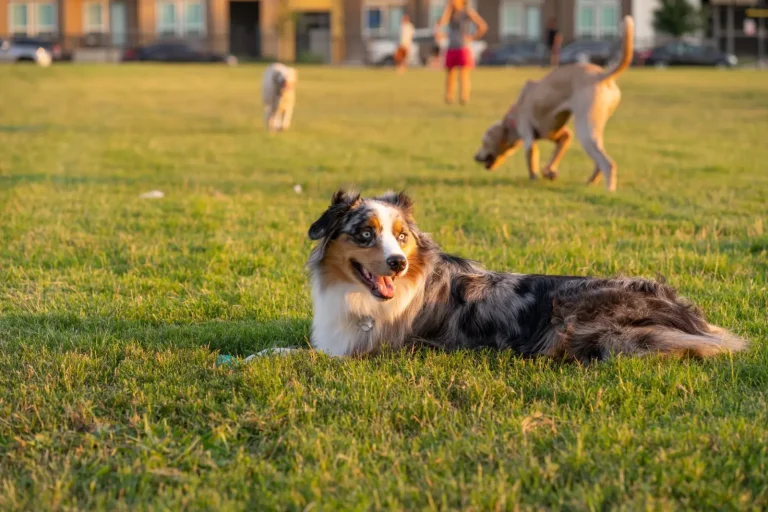
An Aussie with solid focus in your backyard might look completely scattered at a dog park or on a busy street. This isn’t inconsistency or failure. It’s the dog reading the environment correctly. High-stimulation environments are harder for any dog to focus in, and Aussies, with their herding instinct and high prey drive, can be particularly susceptible to environmental pull.
Building focus in distracting environments is a gradual process. It requires starting in lower-distraction settings and slowly increasing difficulty. It also requires accepting that perfect focus in a high-stimulation environment is often unrealistic. The dog that makes eye contact with you sixty percent of the time while other dogs are playing nearby is actually doing well. The dog that ignores you entirely is a dog that hasn’t learned to prioritize you in that context yet.
I’ve found that Aussies respond well when the owner accepts these environmental realities and works within them. A dog that has learned to check in with you regularly, even if not constantly, is a dog with functional focus. That’s usually enough for safety and reliability in most real-world situations.
The dog that seems to have perfect focus everywhere is often a dog that’s either been heavily drilled or is naturally lower-drive. Neither is necessarily better. A high-drive Aussie that’s learned to focus on you most of the time, with occasional lapses, is often a healthier, happier dog than one that’s been trained into constant compliance.