

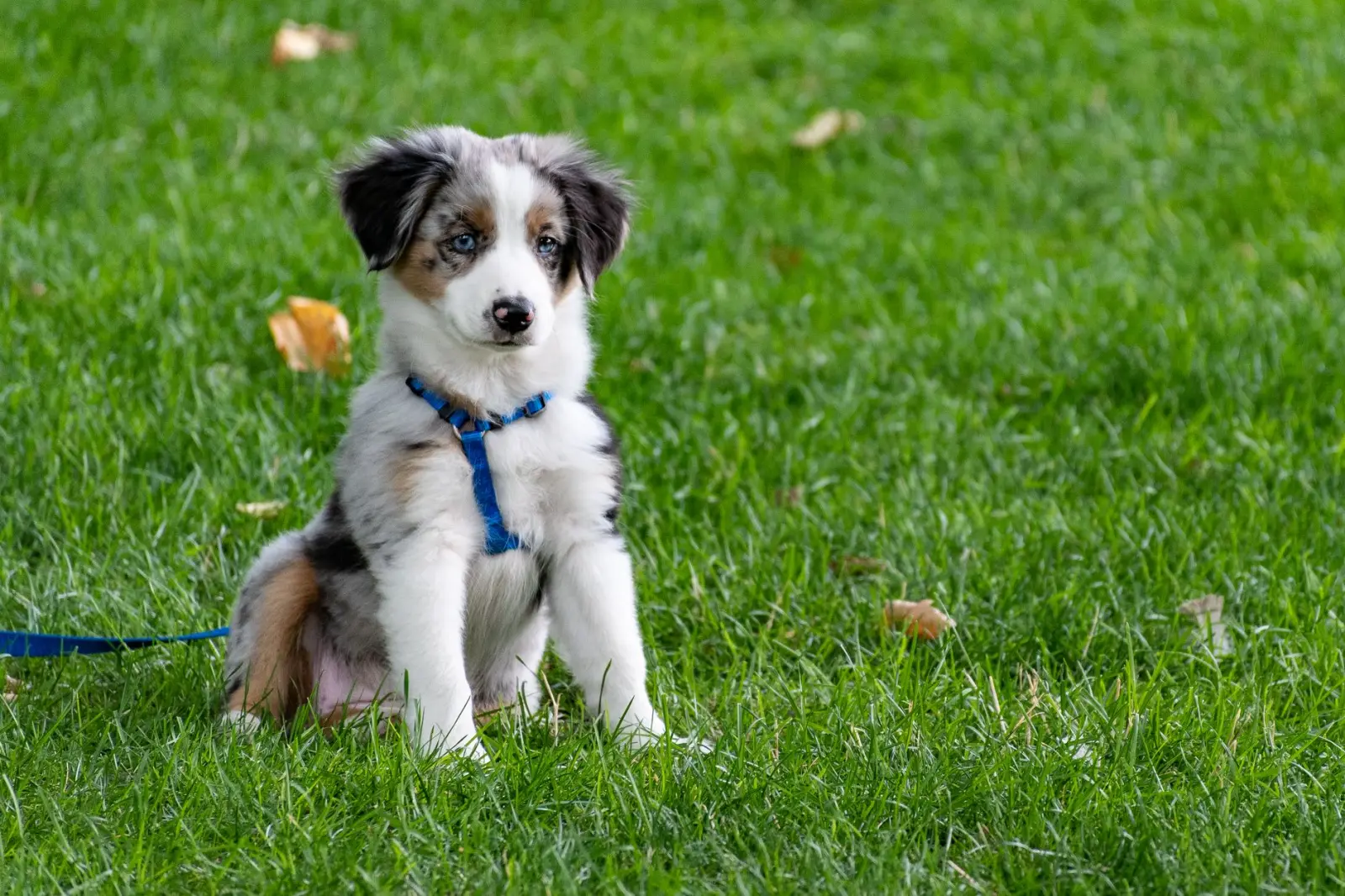
Australian Shepherd puppies arrive with a particular kind of energy. They’re not hyperactive in the way some breeds are – they’re driven. There’s a difference. After years of working with these dogs from eight weeks onward, I’ve noticed that owners often misread this drive as simple restlessness, when it’s actually a strong internal pull toward work, problem-solving, and structure. Understanding that distinction shapes everything about how you approach training with them.
The first thing that strikes most people is how quickly these puppies engage with their environment. By ten weeks, a healthy Australian Shepherd is already watching you intently, reading your movements, and forming opinions about what works and what doesn’t. This isn’t something you need to teach them to do – it’s built in. What you’re actually doing during early training is channeling that attention and drive into behaviors that make sense in your household, rather than trying to create engagement from scratch.
The timeline people typically ask about breaks down into phases that don’t always align with what you might expect. The first eight to twelve weeks is about establishing basic household patterns and teaching the puppy how to learn. The twelve to sixteen week window is when you can start introducing more structured obedience work. Between four and six months, most Australian Shepherds develop enough impulse control and focus that formal training becomes genuinely productive. Before that point, you’re building foundation, not expecting polish.
Early Weeks and the Attention Foundation
When a puppy first comes home, the training that matters most isn’t sit or down. It’s teaching the puppy that paying attention to you is rewarding. Australian Shepherds will do this naturally to some degree because of their herding heritage, but you need to make it explicit and consistent. I’ve found that brief, frequent interactions work far better than longer sessions. A puppy at eight to ten weeks can focus for maybe two to three minutes before their brain needs a break. Trying to push beyond that creates frustration on both sides.
Housebreaking tends to progress faster with this breed than with many others, partly because they’re responsive to routine and partly because they genuinely dislike soiling their sleeping space. The key is recognizing that a puppy’s bladder control is a physical limitation, not a behavioral one. At eight weeks, a puppy typically needs to go out every two to three hours. At twelve weeks, that stretches to four hours. This isn’t negotiable – it’s biology. What you’re managing is consistency and opportunity, not willpower.
During this phase, crate training becomes invaluable, but not for the reasons people usually think. The crate isn’t punishment or confinement in the way some people frame it. For an Australian Shepherd puppy, it’s a den – a space where they can settle without the constant sensory input of the household. These puppies are naturally alert and reactive to movement and sound. A crate gives them permission to rest, which they often need but don’t always take on their own.
The Twelve to Twenty Week Window
This is when you can begin introducing basic obedience commands with some real structure. The puppy’s attention span has lengthened, and their ability to understand cause and effect has matured enough that training feels less like play and more like actual learning. I typically start with sit because it’s easy to lure, easy to reward, and gives the puppy early success. That success matters more than the command itself at this stage.
Socialization during this window is critical, but it’s often done incorrectly. People assume socialization means exposing the puppy to as many dogs and people as possible. For Australian Shepherds, it’s more nuanced. These dogs have a natural wariness that’s actually useful – it makes them good watchdogs. What you’re socializing them to is not being fearful of new situations while maintaining that healthy caution. A puppy who has met thirty dogs in a chaotic dog park might be more stressed than one who has met five dogs in calm, controlled settings.
Leash training begins in earnest around this age. Australian Shepherd puppies don’t naturally walk politely on a leash the way some breeds might. They pull, they dart, they want to investigate everything. This is the herding instinct expressing itself. Rather than fighting it, I teach them that forward motion happens when the leash is slack and stops when they pull. It takes repetition, but the breed’s intelligence means they grasp the connection quickly once they understand what you’re asking.
Four to Six Months: The Difficult Middle
This period is often harder than people expect. The puppy is larger, more capable, and increasingly independent-minded. They’ve learned some basic commands, but they’re also testing boundaries in ways they didn’t before. Teething is in full swing, and the discomfort can make them irritable and less responsive. I’ve seen owners interpret this as the puppy “forgetting” training or becoming stubborn. Usually it’s just a phase where the puppy is physically uncomfortable and mentally developing a stronger sense of self.
Training sessions can now extend to five to ten minutes, and the puppy can handle more complexity. This is when you might introduce stay, come with some reliability, and begin working on impulse control around distractions. The key is that Australian Shepherds at this age are still very much puppies. They have bursts of focus followed by complete distraction. Expecting consistent performance across all situations is unrealistic.
Exercise requirements increase noticeably around four months. A tired Australian Shepherd puppy is a calmer, more trainable puppy. This isn’t just about running them around. It’s about giving them work – puzzle toys, training sessions, games that engage their problem-solving drive. A puppy who has spent an hour solving puzzles and working through training exercises will settle more easily than one who has simply run in circles.
Six Months to One Year: Building Reliability
By six months, an Australian Shepherd puppy has the physical and mental capacity to begin learning more complex behaviors and to show real reliability in basic commands. This is when training becomes less about introducing new things and more about reinforcing what they know under increasingly difficult conditions. A sit that works perfectly in your living room might fall apart at the dog park. That’s not a failure – it’s a stage of learning that requires practice in different environments.
Recall becomes increasingly important and increasingly challenging during this period. Australian Shepherds have a moderate prey drive and a strong desire to investigate their environment. Teaching reliable recall isn’t something you do once and then forget about. It’s something you practice consistently, with high-value rewards, in gradually more distracting situations. I’ve found that puppies who have practiced recall in boring environments first tend to generalize it to exciting ones more easily than those who only practice in high-distraction settings.
Adolescence brings another round of boundary testing. A puppy at eight months might suddenly ignore commands they’ve known for months. This is normal and temporary. It’s less about the training failing and more about the puppy’s brain developing independence and risk assessment. Consistency during this phase is what carries you through. Backing off training or becoming frustrated tends to extend the phase rather than shorten it.
Throughout this entire period, what distinguishes Australian Shepherds from many other breeds is their responsiveness to structure and their need for it. They don’t thrive with inconsistent rules or vague expectations. They also don’t respond well to harsh corrections – their sensitivity means they shut down rather than learn. The most effective approach I’ve found is clear expectations, consistent consequences, and immediate rewards for correct behavior. It’s not complicated, but it does require follow-through.