
Australian Shepherds arrive with built-in intensity. They’re herding dogs bred to work all day, think independently, and respond to subtle cues. When people bring one home and expect a relaxed companion, they’re usually surprised by week two. The dog isn’t misbehaving – it’s just operating at a frequency most households aren’t prepared for. Training these dogs isn’t about teaching them to sit or stay. It’s about giving their mind and body a productive outlet before they invent their own.
The real starting point has nothing to do with commands. It’s establishing a rhythm. Australian Shepherds thrive on consistency and structure, not because they’re rigid dogs, but because they’re sensitive to what’s expected. A dog that knows when it will exercise, when it will eat, when training happens, and what happens next settles faster than one living in an unpredictable environment. This matters more in the first few weeks than any formal obedience work.
Physical exercise alone won’t solve the puzzle. A tired Australian Shepherd is a quieter Australian Shepherd, yes, but a bored one that’s also tired is still a problem. These dogs need their brains engaged. A 45-minute walk where the dog just follows you isn’t nearly as useful as 15 minutes where you’re asking it to think – to navigate obstacles, to wait for permission, to make choices under guidance. The mental fatigue is what actually settles them.
Building Foundation Before Commands
Most people want to start with sit and down. There’s nothing wrong with that, but it’s treating the symptom. Before formal commands make sense, the dog needs to understand the basic contract: you make decisions, I follow them. This happens through everyday interactions, not training sessions. It’s the way you walk through a doorway first, not the dog. It’s the way the dog waits for permission to eat. It’s the way attention to you becomes rewarding in itself.
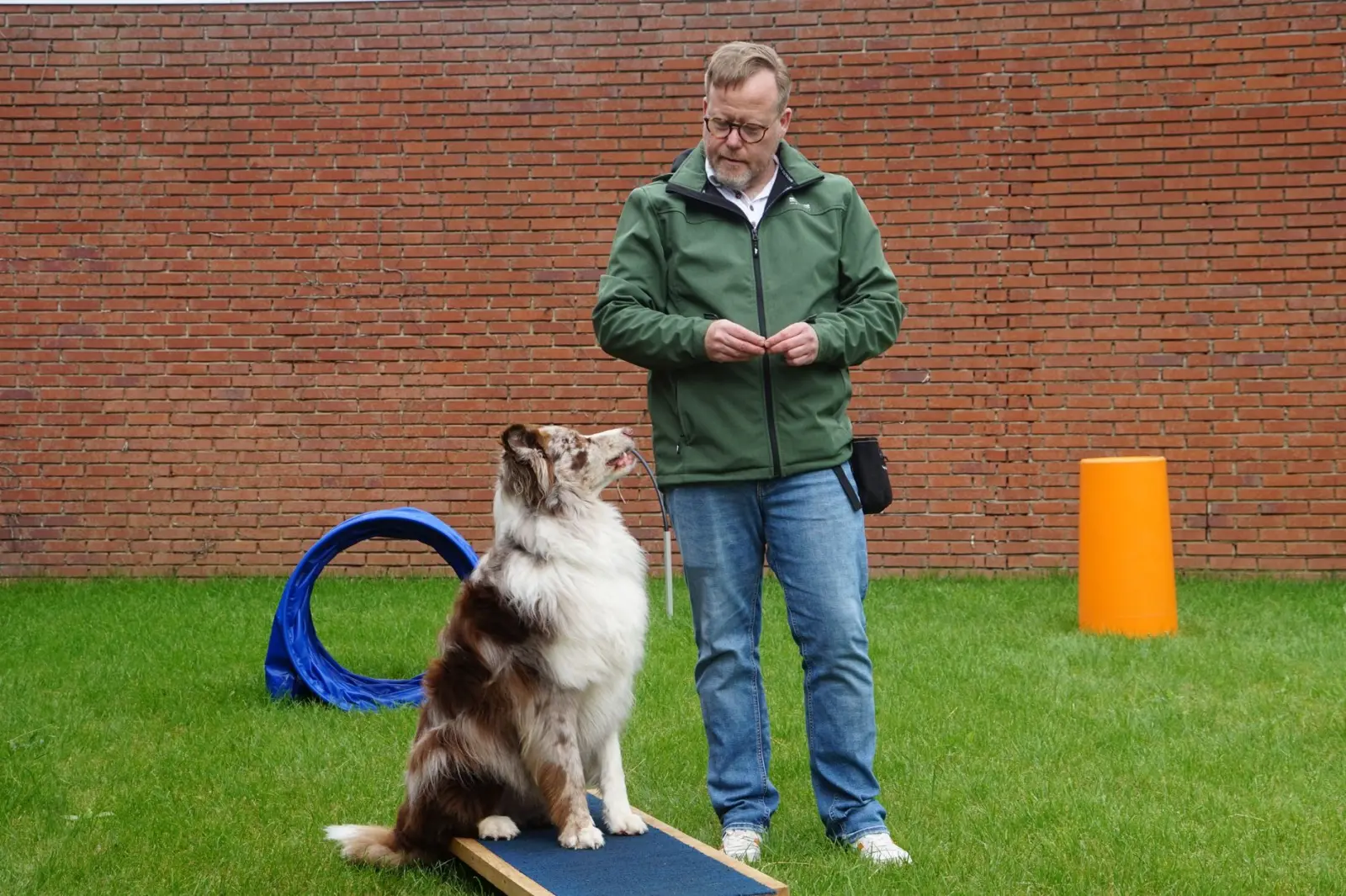
Attention is the foundation. An Australian Shepherd that will look at you when you ask, even briefly, is a dog you can work with. Everything else builds from there. The way to develop this isn’t through repetition drills. It’s through making yourself interesting. When you have something the dog wants – food, a toy, access to the yard – you become the decision-maker. Early on, I spend time just rewarding the dog for noticing me without being asked. A glance your way gets marked and rewarded. This sounds simple because it is, but it’s also where most training fails. People skip it and jump to commands the dog doesn’t yet care about.
Managing the Herding Drive
Australian Shepherds will herd. They’ll herd other pets, children, moving objects, shadows. This isn’t a behavior problem – it’s what they were built to do. You can’t train it away, and punishing it usually makes it worse because the dog is just doing what feels natural. What you can do is redirect it and give it appropriate outlets.
Flirt poles, herding balls, and controlled play with toys that move unpredictably scratch this itch. Some dogs benefit from actual herding work if you have access to it. The point is giving the drive somewhere to go. When a young Australian Shepherd is nipping at heels or stalking movement, it’s not being dominant or stubborn. It’s being a herding dog. Channeling it is more effective than fighting it.
Managing the environment matters too. If the dog is constantly in situations where it’s herding children or other pets, you’re fighting an uphill battle. Separation, supervision, and redirecting before the behavior gets rewarding are practical tools. Once the dog has learned that herding gets attention – even negative attention – it becomes self-reinforcing.
Early Socialization Within Reason
Australian Shepherds can be cautious with unfamiliar people and situations. This isn’t shyness or fear necessarily – many are just reserved. The breed tends toward watchfulness. Early exposure to different environments, sounds, and people helps, but it has to be done thoughtfully. Flooding a young dog with too much too fast, or forcing interaction when the dog isn’t ready, can backfire.
Positive exposure works better than forced interaction. Letting the dog observe new situations from a distance, rewarding calm behavior, and letting the dog approach at its own pace builds confidence without creating anxiety. Some Australian Shepherds are naturally outgoing. Others are more reserved. Both are normal for the breed. Pushing a reserved dog to be social often makes it more reserved, not less.
When to Expect Progress
Training an Australian Shepherd shows results quickly if you’re doing the foundational work. Within a few weeks, you’ll notice the dog checking in with you more often, settling faster, and responding to basic cues without much repetition. These dogs are smart enough that they often learn what you’re asking on the first or second exposure. The challenge is usually consistency from the handler, not the dog’s ability to learn.
Around three to four months, many Australian Shepherds start showing their personality more clearly. They’re less reactive to novelty, more confident in routine, and better able to handle impulse control. This is also when the teenage phase can hit – the dog knows what you want but decides whether it feels like complying. This is normal development, not a training failure. Staying consistent through it matters.
The dogs that struggle most are usually those whose handlers haven’t committed to the structure piece. An Australian Shepherd in a chaotic household with inconsistent rules and sporadic exercise will test boundaries constantly. The same dog in a structured environment with clear expectations and adequate mental stimulation settles into a predictable, cooperative partner relatively quickly. The breed responds to clarity.