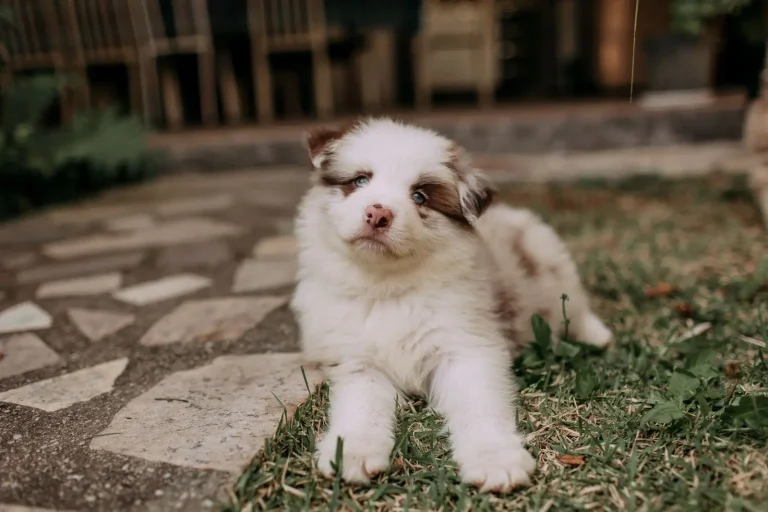


Australian Shepherd puppies begin losing their baby teeth around three months of age, though the exact timing varies between individuals. By the time they reach six or seven months, most have shed their entire deciduous set and are working with their permanent adult teeth. This transition is straightforward in most cases, but it’s worth understanding what’s happening and when something warrants attention.
The process isn’t instantaneous. A puppy doesn’t wake up one morning with all new teeth. Instead, the adult teeth gradually push up from below the gum line, loosening the baby teeth as they go. You’ll notice this happening unevenly across the mouth. One side might be well ahead of the other, or the front teeth might be done while the back molars are still loose. This staggered pattern is normal and reflects how the teeth develop under the surface before erupting.
What you’ll actually observe depends on how closely you’re looking. Some puppies shed teeth so gradually that owners barely notice. Others leave small teeth scattered around the house or embedded in toys. The teeth themselves are tiny – the incisors are almost needle-like – so they’re easy to miss in bedding or on the floor. Many owners find them by accident, discovering a baby tooth stuck between sofa cushions or tangled in a blanket.
The Timeline in Practice
Incisors typically come loose first, usually between three and five months. These are the small front teeth, and they’re the least critical for function, so their loss doesn’t affect eating. The canines follow next, usually around four to six months. Then come the premolars, which are larger and take longer to shed. The molars are last, and they can take until seven months or even slightly beyond to fully erupt and settle.
Australian Shepherds, being a medium-sized breed, tend to follow this general timeline fairly reliably. Smaller dogs sometimes finish earlier, while larger dogs occasionally stretch it out. I’ve seen puppies complete the transition by five months and others that weren’t fully done until eight. Genetics plays a role here, and so does individual development rate.
During this period, you might notice your puppy chewing more intensely than usual. This isn’t random behavior. The pressure and movement of chewing actually helps loosen the baby teeth and encourages the adult teeth to come in properly. It’s uncomfortable, not painful in most cases, but the sensation drives them to seek relief through chewing. This is why providing appropriate chew toys during teething matters more than many people realize.
What Happens When Baby Teeth Don’t Fall Out
Retained baby teeth are the main issue I see with Australian Shepherds during this phase. Occasionally, the permanent tooth comes in but the baby tooth doesn’t shed. This happens more often with the canines and premolars. When it does occur, you end up with two teeth in the space where one should be. The baby tooth typically sits slightly in front of or behind the adult tooth.
This isn’t immediately dangerous, but it does matter. The extra tooth creates a tight space where food and debris can accumulate, increasing the risk of gum disease down the line. More importantly, the misalignment can affect how the teeth come together when the mouth closes. In some cases, it can contribute to bite problems that become more pronounced as the dog matures.
If you notice a baby tooth still present when the adult tooth has clearly erupted behind it, mention it to your veterinarian at the next visit. Some retained baby teeth eventually fall out on their own, but many don’t. Extraction is straightforward and usually happens during a routine dental procedure. It’s far easier to address this at six or seven months than to deal with the consequences later.
Managing Discomfort and Behavior
Australian Shepherd puppies during teething tend to be mouthy. They chew more, they mouth hands and clothing more readily, and they’re generally more interested in putting things in their mouths. This isn’t disobedience. It’s a physical need. Redirecting this energy toward appropriate toys rather than trying to suppress it entirely works better in my experience.
Cold toys help. A wet washcloth frozen in the freezer and offered to the puppy provides both the pressure they’re seeking and a numbing effect that eases discomfort. Rubber toys designed for teething are useful, though Australian Shepherds are smart enough to figure out which toys are worth their attention. They’ll often ignore a boring teething ring in favor of something more interesting.
Some puppies eat less during heavy teething phases. This is usually temporary and not a cause for concern if it’s mild. If a puppy is refusing meals or seems painful, that’s worth investigating. Occasionally, an erupting tooth causes enough inflammation that eating becomes uncomfortable. In those cases, softening food temporarily or offering smaller, more frequent meals helps.
Pain medication is rarely necessary. Most puppies manage the discomfort without it. If a puppy seems genuinely distressed, your veterinarian can advise on whether any intervention is appropriate, but this is uncommon in healthy Australian Shepherd puppies.
Monitoring Tooth Development
By eight months, you should see a full set of adult teeth. Australian Shepherds have 42 permanent teeth total: 12 incisors, 4 canines, 16 premolars, and 10 molars. The arrangement matters for their bite. A proper scissor bite – where the upper teeth overlap the lower teeth slightly – is what you’re looking for. If teeth are crowded, rotated, or meeting in an unusual way, that’s worth mentioning to your vet.
Bite issues can develop during teething if baby teeth are retained too long or if permanent teeth erupt in unusual positions. Most Australian Shepherds develop normal bites, but the breed isn’t immune to problems. Monitoring during this transition helps catch anything unusual early.
The teething phase is temporary, and most owners find it manageable with the right approach. Providing appropriate outlets for chewing, staying alert for retained teeth, and understanding that increased mouthing is normal behavior gets you through it without drama. By nine months, the transition is complete, and you’re left with a full set of adult teeth that should last the dog’s lifetime with proper care.