After years of working with Australian Shepherds, I’ve learned that their body structure tells you almost everything about how they’ll move, perform, and age. The build isn’t just about appearance. It determines whether a dog can sustain the demands of herding work, how efficiently they’ll move across rough terrain, and what structural weaknesses might develop over time. Most people notice the coat and the energy level first, but the skeleton underneath is where the real story lives.
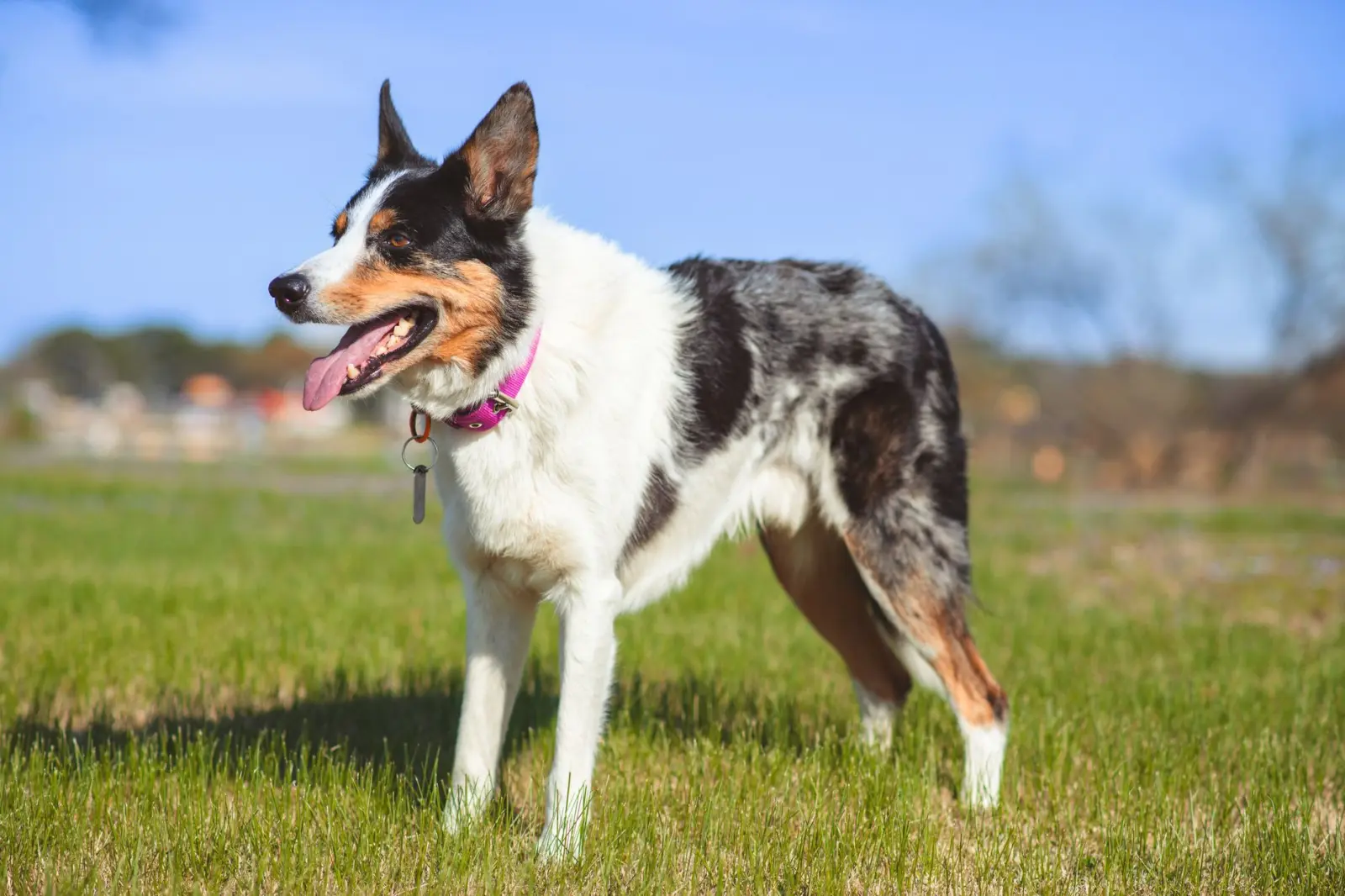
The Australian Shepherd is a medium-sized dog built for sustained work, not speed or bulk. Males typically stand 20 to 23 inches at the shoulder, with females slightly smaller at 18 to 21 inches. The weight range sits around 40 to 65 pounds depending on sex and individual frame. What matters more than these numbers is the proportion between height and length. A well-structured Aussie is slightly longer than it is tall – not dramatically, but noticeably. This length comes from the ribcage and loin, not from stretched-out legs. That extra length in the body gives them the reach and flexibility they need to turn sharply and maintain balance on uneven ground.
The Shoulder and Front Assembly
The front end of an Australian Shepherd should move as a unit with the rest of the body, not in isolation. The shoulder blade sits at roughly a 45-degree angle, which allows the front leg to extend well forward without the elbow swinging out or in. I’ve watched many Aussies with upright shoulders compensate by moving their elbows away from their ribs, which wastes energy and creates a choppy stride. When the angle is correct, the leg swings like a pendulum beneath the body, and the dog covers ground with minimal effort.
The upper arm – the bone between shoulder and elbow – should be nearly equal in length to the shoulder blade itself. When these two bones are balanced, the front leg can reach forward and backward in a smooth arc. If the upper arm is too short relative to the shoulder, the stride shortens, and the dog’s front end can’t keep pace with the rear drive. This creates a hitching or unbalanced gait that becomes more pronounced over distance.
The elbows sit directly beneath the shoulder joint when the dog stands naturally. They should be close to the ribcage, not splayed out to the sides. Elbows that turn outward often signal either a structural issue in the shoulder or compensatory movement from a longer or weaker loin. In working dogs, this matters because loose elbows mean the dog tires faster and places uneven stress on the joints.
The Ribcage and Topline
The chest is deep and well-sprung, extending to roughly the point of the elbow. This depth gives the lungs and heart plenty of room to work during sustained activity. I’ve noticed that Aussies with shallow chests often struggle with endurance, even if they appear energetic in short bursts. The ribs spring out from the spine and then taper toward the sternum, creating an oval or egg-shaped cross-section rather than a barrel or slab-sided appearance.
The back itself should be strong and level from the withers to the hip. The loin – the area between the last rib and the hip – is short and muscular. A long, weak loin is a common structural fault that I’ve seen correlate with back problems later in life. The shorter, tighter loin gives the dog stability and allows the rear legs to drive power forward without the spine flexing excessively. When you run your hand along the back of a structurally sound Aussie, you should feel a slight rise at the withers, then a level plane, with no sag or roach.
The Hindquarters and Drive
The rear end of an Australian Shepherd is where the power originates. The pelvis is set at an angle that complements the shoulder angle – ideally around 30 degrees from horizontal. The hip joint, formed where the femur meets the pelvis, sits at an angle that allows the rear leg to extend well behind the body and flex well under it. This range of motion is essential for the explosive turns and sustained movement that herding work demands.
The upper thigh bone, or femur, should be roughly equal in length to the lower leg bone below the knee. When these proportions are balanced, the dog can drive from the hip without overextending or underreaching. The stifle angle – the bend at the knee – should be moderate, roughly matching the angle of the elbow in front. If the stifle is too straight, the dog’s stride becomes rigid and jarring. If it’s too bent, the rear legs can’t extend far enough, and the dog loses power and efficiency.
The hock joint, which corresponds to the human ankle, should be relatively short and strong. A long hock creates a mechanical disadvantage and places extra stress on the joint during work. The rear feet should point straight ahead, not turning in or out. Rear feet that splay outward often indicate hip dysplasia or compensatory movement from a weak loin or steep pelvis.
Angulation and Movement
What I’ve observed repeatedly is that balanced angulation between front and rear is more important than having extreme angles in either direction. An Australian Shepherd with well-matched shoulder and hip angles moves in a coordinated way. The front and rear legs reach and drive in harmony, and the spine stays relatively still. When the front is too upright and the rear is too angled, or vice versa, the dog has to compensate through the loin, which creates stress and inefficiency.
The gait itself should be smooth and ground-covering. A trotting Aussie should move with minimal vertical bounce and maximum forward progress. The front legs should reach out without overextending, and the rear legs should drive through without overreaching. When viewed from behind, the rear legs should track nearly parallel to the front legs, not crossing over or splaying. This straight tracking comes from correct hip and stifle angles combined with a strong loin that keeps the spine stable.
Common Structural Variations
Not every Australian Shepherd will fit the ideal proportions perfectly, and some variations are more significant than others. A slightly upright shoulder or a slightly steep pelvis might not prevent a dog from working or living a normal life, but it does affect how they move and where stress accumulates over years. I’ve seen dogs with minor structural faults that lived long, healthy lives because their owners managed activity appropriately. I’ve also seen dogs with ideal structure that developed problems due to poor conditioning or overwork.
Rear angulation that’s too steep – where the pelvis is nearly vertical – is something I’ve noticed correlates with early hip dysplasia and hind-end weakness. Similarly, a very long loin or a weak connection between the ribcage and hip can lead to back soreness or instability. These aren’t always obvious from a quick glance, but they become apparent when you watch the dog move over distance or during work.
The Australian Shepherd’s structure is fundamentally about efficiency and endurance. The breed was developed to move livestock across rough terrain for hours at a time, and the skeleton reflects that purpose. Understanding how the pieces fit together helps explain why some dogs seem to move effortlessly while others appear to labor, and why certain structural issues tend to show up in predictable ways as the dog ages. The build is a blueprint for how the dog will perform and what to watch for over time.