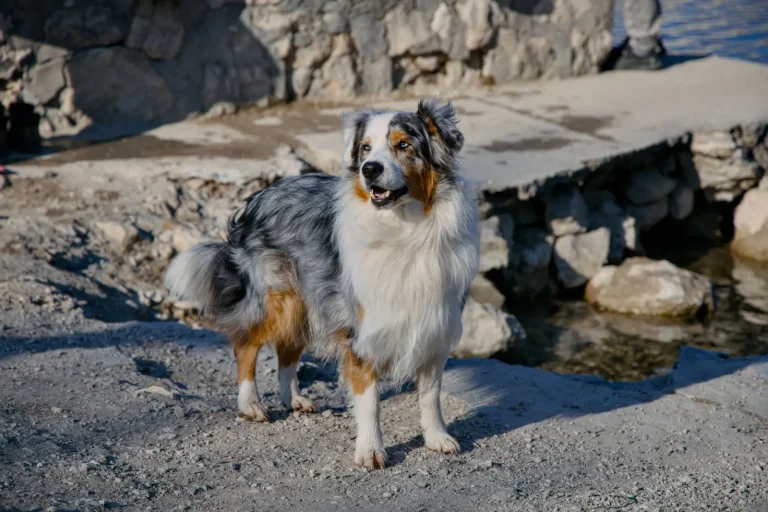


Australian Shepherds are built for work that involves constant directional changes, sustained focus, and responsive movement across variable terrain. When you run with one, you’re not simply moving forward at a steady pace. You’re managing a dog whose instincts pull in multiple directions simultaneously – literally and mentally.
The first thing most people notice is that an Aussie doesn’t run like a retriever or a pointer. There’s no long, loping stride aimed at covering distance. Instead, you get frequent direction shifts, sudden stops to assess surroundings, and an almost constant state of readiness. This isn’t disobedience or poor training. It’s the breed’s herding heritage expressing itself. The dog is scanning, anticipating, and reacting to environmental stimuli in real time.
I’ve run with Aussies in open fields, on trails, and through neighborhoods. The environment matters enormously. In a wide-open space, the dog often settles into a more predictable rhythm once the initial mental mapping is done. In populated or complex environments – trails with turns, neighborhoods with intersections – the energy remains scattered. The dog’s attention fragments across multiple points of interest, which translates into unpredictable pace and direction.
Pacing and the Distance Problem
Most Aussies can physically sustain running for extended periods. Their endurance is genuine. But there’s a difference between can and should, and that distinction matters more with this breed than with many others.
An Aussie running alongside you isn’t simply exercising. The dog is working – mentally processing the run as a task with variables to manage. This cognitive load, combined with physical exertion, depletes the dog faster than raw distance suggests. A 5-mile run with an Aussie often produces the same fatigue level as an 8-mile run with a Labrador, because the Aussie’s brain is engaged throughout.
Pacing itself becomes a negotiation. The dog wants to run faster on some segments, slower on others, depending on what’s happening around you. Maintaining a consistent speed requires either constant correction or choosing routes where the dog naturally settles. Flat, predictable terrain helps. Repetitive routes help. The dog learns the route and stops treating every segment as novel information that requires processing.
Heat and Recovery Considerations
Aussies have moderate coats – not short, not long – which affects heat management during runs. They don’t overheat as quickly as heavy-coated breeds, but they also lack the cooling efficiency of short-haired dogs. Temperature matters more than many runners realize. A 70-degree morning run is manageable. An 80-degree afternoon run becomes genuinely taxing, and the dog’s mental state often deteriorates before physical exhaustion sets in.
Recovery is where the mental component becomes most obvious. After a run, an Aussie doesn’t simply rest. The dog often remains in a heightened state for 30 minutes or longer – alert, somewhat restless, still processing the experience. This isn’t unusual; it’s normal for the breed. Providing a calm space, water, and time to decompress matters more than it does with breeds that switch off more readily.
The Behavioral Shift During and After Running
One consistent observation: running changes an Aussie’s behavior in ways that extend beyond simple exercise. A dog that’s somewhat reactive or anxious at home often becomes more controlled during a run. The structured activity, the forward momentum, and the clear purpose seem to settle the dog’s nervous system. Conversely, a dog that’s already high-energy can become more intense if the run is too stimulating or if the route involves high-distraction environments.
This matters for timing and route selection. Running an Aussie in the early morning, before the neighborhood is fully active, produces a different dog than running the same distance in the afternoon. The dog’s ability to settle depends partly on what the environment presents.
After running, some Aussies are calm and focused. Others remain in a heightened state for hours. This variation isn’t random – it relates to what happened during the run, how much mental stimulation occurred, and the individual dog’s temperament. A run that felt productive and manageable often leads to a calmer evening. A run that involved high-distraction or constant corrections can leave the dog wired.
Frequency and Sustainable Patterns
Running with an Aussie three or four times weekly works well for most dogs in this breed. Daily running, while physically possible, often leads to diminishing returns. The dog becomes either too dependent on the activity as an outlet or, conversely, develops patterns of overexcitement around running time.
Mixing running with other activities – training sessions, varied play, mental work – tends to produce better overall behavior than running alone. An Aussie that runs four times weekly but also does obedience work, puzzle toys, or herding-type games settles more consistently than a dog that runs daily but has no other structured engagement.
The sustainable pattern depends on the individual dog’s age, baseline energy, and what else is happening in its life. A young Aussie with a job or regular training commitment can handle more running. An older dog or one without other structured engagement often does better with moderate running frequency and more varied activities.
Running with an Australian Shepherd is manageable and often rewarding, but it requires accepting that you’re not just moving distance. You’re managing a dog whose mind is as active as its body, whose attention is distributed across the environment, and whose recovery involves more than physical rest. The runs that work best are the ones where you stop expecting a simple forward motion and instead work with the dog’s actual nature – responsive, alert, and always processing what’s happening around it.