
Australian Shepherds chase cars because it feels natural to them. This isn’t a behavioral flaw or a training gap – it’s hardwired herding instinct expressing itself in an environment full of moving objects. After years of working with this breed, I’ve found that owners often approach car chasing as though it’s a simple obedience problem, when it’s actually a management challenge combined with understanding what the dog is trying to do.
The breed was developed to move livestock across open terrain, which means their entire nervous system is tuned to notice movement, react to it, and pursue it. A car moving at speed triggers something primal. The dog isn’t trying to be destructive or disobedient – the dog is doing what its genetics have prepared it to do. Recognizing this distinction changes how you address the problem.
What I’ve observed is that the severity of car chasing varies significantly between individual dogs. Some Australian Shepherds show mild interest in passing vehicles and can be redirected easily. Others become fixated, bolting toward the street without hesitation, which is genuinely dangerous. The difference often comes down to early exposure, individual temperament, and how much the behavior has been reinforced over time.
Exercise and Mental Engagement Matter More Than Most Realize
The first thing I notice when meeting an Australian Shepherd with a serious car-chasing problem is usually the same thing: insufficient outlet for their energy and drive. This breed needs substantial daily activity – not just a walk around the block. They were bred to work eight hours a day in variable terrain, making decisions about livestock movement. A typical suburban routine doesn’t come close to meeting that need.
When these dogs don’t have adequate exercise and mental stimulation, they become hyperfocused on whatever stimulation is available. A car becomes a substitute for the work they’re designed to do. I’ve seen dramatic improvements in car chasing simply by increasing the dog’s daily activity level – not just physical exercise, but work that engages their problem-solving ability. This might be herding trials, agility training, or structured games that require decision-making.
The mental component is often overlooked. An Australian Shepherd that spends two hours a day doing meaningful work – whether that’s actual herding, fetch games with rules, or puzzle-based training – is far less likely to chase cars than one that gets thirty minutes of leash walking. The difference isn’t subtle. I’ve worked with dogs where owners added just one structured training session daily and saw the car chasing diminish within weeks.
Management Is Your Primary Tool
Before you can change behavior, you have to prevent the dog from practicing it. This is where many owners struggle because it requires consistent, ongoing vigilance rather than a training fix. If your Australian Shepherd has access to a front yard where cars pass, and the dog spends time unsupervised there, the behavior will continue to strengthen. Every chase reinforces the pattern.
Secure fencing is non-negotiable. I mean fencing that prevents the dog from seeing the street clearly or accessing the edge where cars pass. A four-foot fence with clear sightlines to traffic isn’t sufficient for a dog with strong car-chasing drive. You need either taller fencing, privacy screening, or a yard configuration where the dog isn’t positioned to watch and react to passing vehicles.
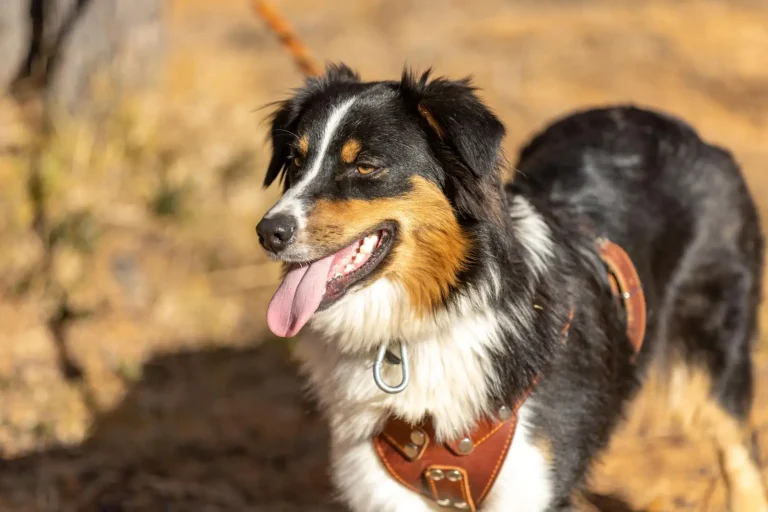
Equally important is controlling leash walks in areas with traffic. This means using a properly fitted harness (not just a collar, which can slip or cause injury if the dog lunges), keeping the dog on a short lead, and crossing streets proactively rather than allowing the dog to approach the curb. Some owners also find it helpful to change their walking routes during the period when they’re working on this issue – avoiding high-traffic areas entirely until the behavior is more controlled.
What Happens During the Chase
Understanding the mechanics of car chasing helps explain why certain interventions work and others don’t. When an Australian Shepherd fixates on a moving car, the dog’s arousal level spikes rapidly. The dog is in a heightened state of drive, and at that moment, most training signals have minimal effect. This is why yelling “come” or “leave it” often fails – the dog’s brain is flooded with adrenaline and herding impulse, and your voice is background noise.
This is also why punishment-based approaches tend to backfire. If you correct the dog after it chases a car, the dog may learn to avoid chasing when you’re watching, but the underlying drive hasn’t changed. The dog hasn’t learned that cars are dangerous or uninteresting – the dog has learned that chasing cars results in consequences when you’re present. The moment you’re distracted or the dog is unsupervised, the behavior resumes.
Building Impulse Control Away From Traffic
The most effective long-term approach involves building the dog’s ability to inhibit impulses in lower-stakes situations first, then gradually introducing the car-chasing scenario. This means teaching the dog to wait, to not chase toys or balls until given permission, and to maintain focus on you even when other things are happening nearby.
Games like “wait” before releasing the dog to fetch, or “leave it” with treats on the ground, strengthen the neural pathways associated with self-control. An Australian Shepherd that has practiced impulse inhibition hundreds of times in safe contexts is more likely to apply that restraint when a car passes. It’s not automatic – the drive is still there – but the dog has a competing behavior pattern that can override the impulse.
I’ve found that combining impulse control training with desensitization to traffic works better than either approach alone. The desensitization part involves exposing the dog to passing cars from a distance where the dog doesn’t react intensely, then rewarding calm behavior. Over time, the distance decreases and the dog learns that cars passing don’t require a response. This is gradual work, though, and it only works if the dog isn’t simultaneously getting practice chasing cars in other situations.
When the Problem Persists Despite Your Efforts
Some Australian Shepherds have such strong chase drive that management and standard training approaches aren’t fully sufficient. In these cases, it’s worth considering whether the dog’s individual temperament is on the extreme end of the spectrum. Not all dogs respond identically to the same interventions, and genetics play a role in how intense the drive is.
For dogs with very high drive, additional strategies might include working with a trainer experienced in impulse control and drive management, exploring whether medication could help reduce arousal levels (something to discuss with your veterinarian), or honestly assessing whether your living situation is compatible with the dog’s needs. An Australian Shepherd with intense car-chasing drive living on a busy street may never be reliably safe, regardless of training.
The reality is that you’re not eliminating the herding instinct – you’re managing it and redirecting it into appropriate outlets. A well-exercised Australian Shepherd with secure management and impulse control training will chase cars far less frequently than an under-stimulated dog with free access to traffic. That’s not perfection, but it’s a meaningful reduction in risk.