

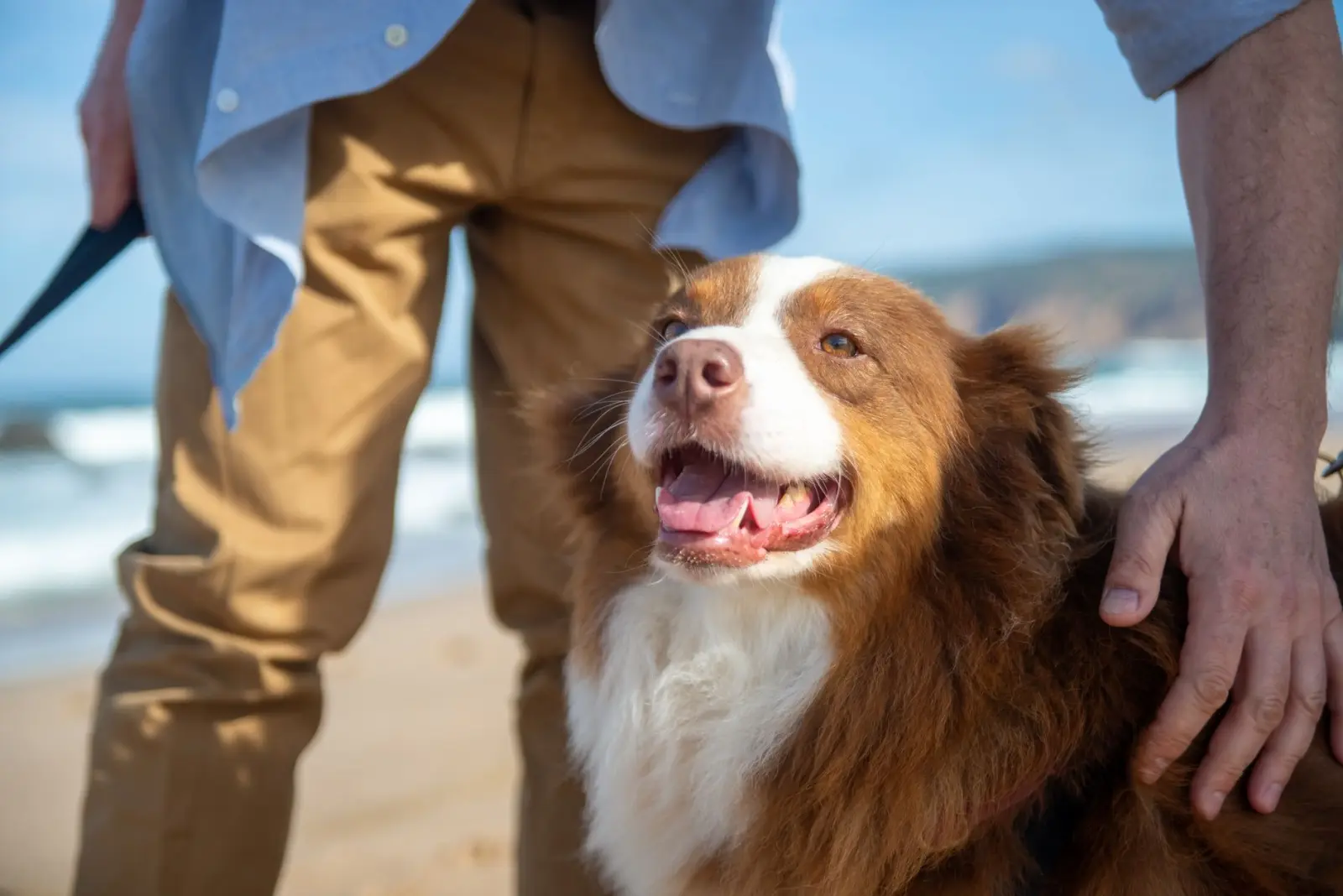
Australian Shepherds earned the label “velcro dog” for a reason, and it’s not exaggeration. Over years of working with this breed, I’ve seen the pattern repeat consistently: these dogs form attachments so strong that they genuinely struggle when separated from their people. It’s not neediness in a trivial sense. It’s a fundamental aspect of how their nervous system is wired, rooted in their history as herding dogs who worked alongside handlers all day.
The intensity catches many owners off guard, even those who’ve researched the breed beforehand. You can read that Australian Shepherds are “people-oriented,” but living with one teaches you what that actually means in practice. A dog that follows you from room to room isn’t being cute – it’s exhibiting a baseline attachment behavior that defines the breed. They don’t just want to be near you; they monitor your location, your mood, your movements. If you get up to use the bathroom, they’re there. If you move to another room, they relocate too.
Why This Attachment Is Different
Not all dogs that follow their owners around are velcro dogs. The difference with Australian Shepherds lies in the consistency and the underlying anxiety when separation occurs. A dog that enjoys your company will hang out nearby. An Australian Shepherd that can’t relax when you leave the house – even briefly – is showing the full spectrum of the trait. I’ve worked with dogs from this breed who genuinely cannot settle if their owner steps outside, even just to grab mail from the curb.
The herding background matters here. These dogs were bred to stay connected to a handler’s movements, to anticipate direction changes, to remain responsive at all times. That genetic predisposition doesn’t disappear in a family home. It translates into a dog that feels most secure when maintaining visual or physical proximity to the person they’ve bonded with. Some dogs handle this more gracefully than others, but the baseline tendency is almost universal in the breed.
Age plays a role too. Puppies are naturally clingy, but Australian Shepherd puppies take it further. By the time they’re adults, many have developed such strong attachment patterns that they struggle with any separation. I’ve seen dogs in this breed who were given space and independence from puppyhood still develop significant separation anxiety by adulthood, simply because the genetic predisposition is that strong.
The Practical Impact on Daily Life
What does velcro behavior actually look like when you’re living with it? It means you can’t leave your dog loose in the house while you run errands without risking destructive behavior or panic responses. It means crate training becomes essential, not optional. It means that casual trips to the store require planning – not because the dog is difficult, but because the anxiety is real and needs to be managed proactively.
Many owners find that their Australian Shepherd does fine in a crate during work hours, provided the dog has been properly conditioned to it. The crate becomes a safe space rather than a prison. But without that structure, or if the dog hasn’t been gradually acclimated to alone time, you’re likely looking at barking, scratching, or destructive behavior. Some dogs will injure themselves trying to escape. Others develop stress-related behaviors like excessive panting or drooling.
The attachment also shows up in less obvious ways. These dogs often struggle with being in a different room with a closed door. They may follow one family member exclusively, ignoring others. They can become reactive if that primary person leaves their sight, even in a familiar environment. I’ve seen Australian Shepherds who panic in veterinary clinics specifically because their owner is in the waiting room but not visible.
Managing the Attachment Without Fighting It
The key insight I’ve come to after working with many of these dogs is that you can’t eliminate the velcro tendency – nor should you try. What you can do is build structure that allows the dog to feel secure while also creating space for you to function independently.
This starts with early and consistent crate training. Not as punishment, but as a genuine safe space. A dog that’s been properly introduced to a crate from puppyhood learns that the space is predictable and secure. When you leave, the dog isn’t abandoned; it’s in a controlled environment where nothing bad happens. This is foundational work, and it’s worth doing thoroughly.
Desensitization to departure cues also matters. Many dogs develop anxiety not because you’re leaving, but because they’ve learned the specific signs that you’re about to leave – grabbing keys, putting on shoes, heading toward the door. If you practice these actions without actually leaving, the dog’s nervous system gradually stops interpreting them as threats. This takes time and consistency, but it works.
Exercise and mental stimulation reduce the intensity of separation anxiety significantly. A tired Australian Shepherd is more likely to settle when alone. A bored one will spiral into anxiety faster. The exercise doesn’t have to be extreme – a solid walk or play session before you leave can shift the dog’s entire response to your absence.
When Velcro Behavior Signals Deeper Issues
There’s a difference between a dog that prefers your company and a dog that cannot function without it. If an Australian Shepherd is showing panic responses – destructive behavior, self-injury, or extreme distress – within minutes of being alone, that’s separation anxiety that may benefit from professional help or, in some cases, medication.
I’ve also seen velcro behavior mask other issues. A dog that’s hyper-focused on one person might actually be insecure or anxious in general, not just attached. A dog that can’t be left alone might have underlying fear responses to noises or environmental triggers that the owner hasn’t identified yet. It’s worth distinguishing between normal breed attachment and anxiety that’s genuinely affecting the dog’s quality of life.
The reality with Australian Shepherds is that you’re adopting a dog that will be deeply connected to you. That connection is part of what makes the breed rewarding – they’re genuinely invested in their people. But it also requires you to be intentional about building independence and managing separation. If you work long hours with no ability to provide breaks, or if you travel frequently and can’t arrange consistent care, this breed may not be the right fit. But if you can work with the attachment rather than against it, Australian Shepherds are capable of being well-adjusted, confident dogs who simply happen to really like being around you.