

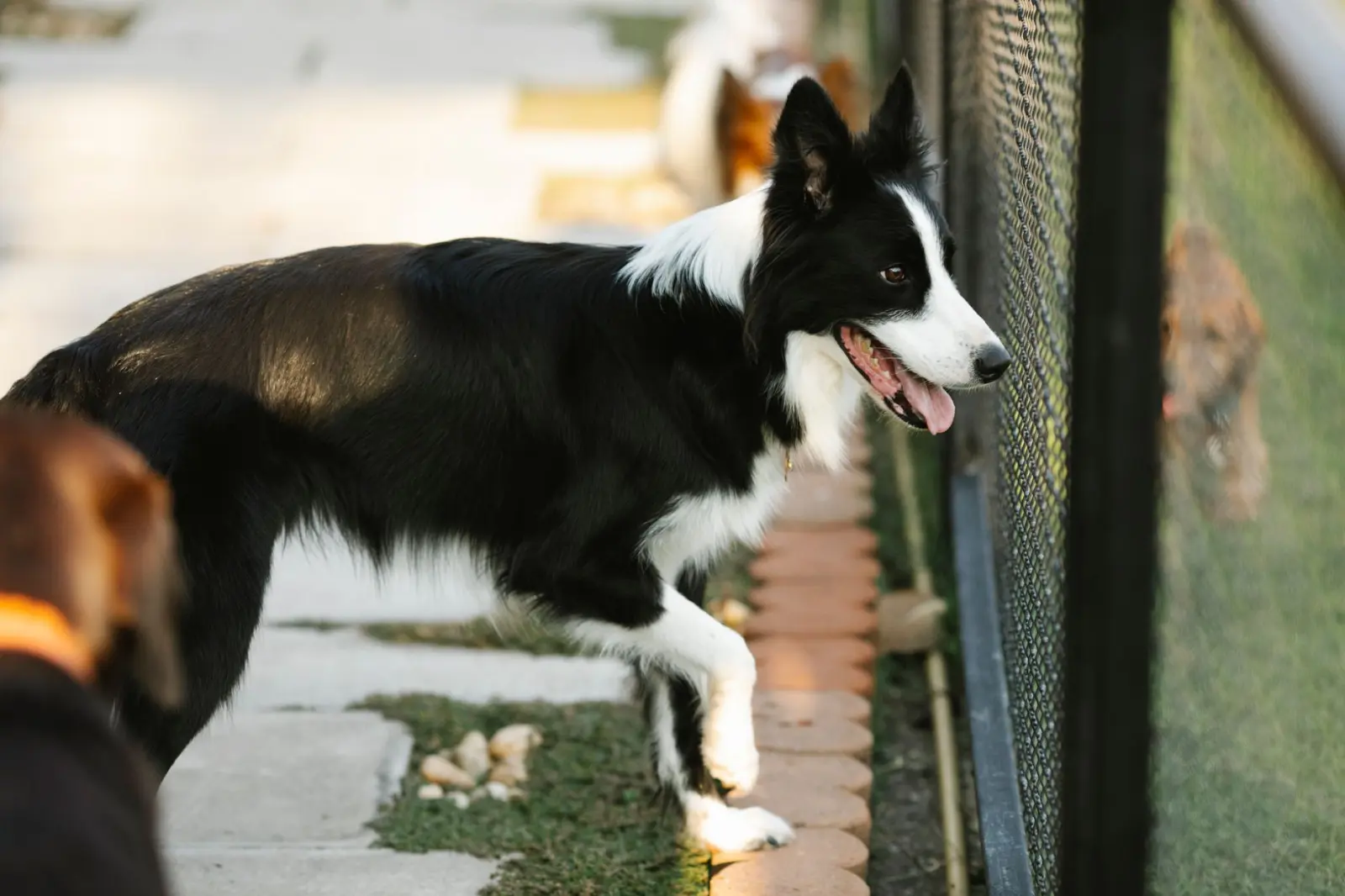
Australian Shepherds approach boundaries differently than most dogs. They don’t simply wander past a fence line out of curiosity or prey drive. They patrol it. They test it. They believe, in some fundamental way, that the space beyond the line is theirs to monitor and control. This comes from generations of herding work, where the ability to move livestock within defined areas was the entire job. When you bring that instinct into a suburban yard or rural property, boundary training becomes less about teaching a dog to stay put and more about redirecting an ingrained working behavior.
I’ve worked with Aussies that could hold a boundary perfectly on command but would drift across it the moment they thought no one was watching. Others would respect a physical fence religiously but lose all sense of limits the instant you removed the barrier. The difference wasn’t intelligence or stubbornness. It was whether the dog understood the boundary as something they had chosen to respect, or something they were forced to obey. That distinction matters enormously when you’re trying to build reliable off-leash behavior.
Why Fencing Alone Fails
A fence is a tool, not a solution. It prevents escape, which is valuable. But it doesn’t teach a dog to respect a boundary when the fence isn’t there. Many owners assume that a dog raised behind a fence will naturally understand property lines, but Aussies don’t work that way. They learn the fence itself – where it is, how high it is, whether it has gaps. They don’t learn the concept of “stay within this invisible line.”
The problem compounds when you want off-leash freedom. You can’t take a fence with you to a park or a friend’s property. And if your dog has spent years respecting only the physical barrier, not the boundary it represents, you’re starting from zero when you remove it. I’ve seen owners frustrated because their Aussie was “perfectly trained” in the yard but bolted across a neighbor’s property the first time they were given freedom elsewhere.
The Role of Herding Drive in Boundary Work
Australian Shepherds don’t have a simple “stay” instinct the way some breeds do. They have a need to move, to control space, to keep things within a perimeter. When you ask an Aussie to respect a boundary, you’re not asking them to be still. You’re asking them to redirect that movement drive in a way that acknowledges the line.
This is why boundary training works best when it’s framed as a job, not a restriction. An Aussie that understands they’re responsible for keeping the yard secure – for monitoring it, patrolling it, protecting it – will often respect the line more reliably than one that’s simply been told “don’t cross.” The difference is psychological. One feels like work. The other feels like a rule they’re testing.
In practice, this means that the most reliable boundary-trained Aussies I’ve encountered were the ones whose owners gave them a role. Some had regular tasks like checking the perimeter, or herding livestock within a defined area. Others had structured play sessions where the dog’s job was to keep a ball or toy within the yard. The boundary became part of their responsibility, not an arbitrary limit.
Building Consistency Without Constant Correction
The instinct to correct every boundary violation is strong, but it’s often counterproductive. If you’re constantly calling your dog back, you’re teaching them that crossing the line is worth the risk – because the worst that happens is they get called back. An Aussie that respects a boundary does so because they’ve decided it’s the right choice, not because they fear consequences.
What actually works is creating situations where the dog succeeds at respecting the boundary and experiences that success as rewarding. This might mean starting with a smaller, more defined area. A dog that can reliably stay within a small section of yard is more likely to extend that behavior to a larger space than one that’s been given too much freedom too quickly.
It also means being selective about when you allow off-leash freedom. Many owners try to train boundaries during casual yard time, when the dog is bored and looking for stimulation. That’s the worst possible moment. Boundary training is more effective when the dog is already satisfied – after exercise, after play, when they’re naturally inclined to stay close. You’re building on existing behavior, not fighting against restlessness.
Environmental Factors and Triggers
Some boundaries are harder to respect than others. A fence line between your yard and a neighbor’s with another dog will be tested more frequently than a quiet property line. Movement on the other side – whether it’s wildlife, people, or other animals – can override months of training in seconds. This isn’t a failure of training. It’s reality.
I’ve found that Aussies often hold boundaries better in familiar environments than in new ones. A dog that respects the line at home might completely ignore it at a rental property or a friend’s house. The boundary itself isn’t the issue. The dog’s confidence in their understanding of that specific space is. This is why some owners have better luck with portable boundary markers – like flags or training bumpers placed at the edge of a space – when they’re working in unfamiliar areas.
Weather and season also play a role, though it’s subtle. Aussies tend to be more focused and reliable during cooler months. In heat or high humidity, their drive to roam increases, and boundaries become less compelling. This isn’t something you can train away. You manage it by adjusting your expectations and supervision during those periods.
When Boundary Training Reaches Its Limits
There’s a point where you have to accept that some Aussies simply have a higher drive to roam than others. Genetics matter. A dog from working lines bred for stock control across large areas might never be as reliably contained as one from show lines or companion-focused breeders. This doesn’t mean boundary training is worthless. It means your realistic goal might be a dog that respects boundaries 90 percent of the time, not 100 percent.
In those cases, management becomes as important as training. A secure fence, a long line for unsupervised outdoor time, or limited off-leash freedom in controlled settings might be the practical answer. Some owners resist this, viewing it as a failure. But it’s actually the more honest assessment. You’re working with the dog’s nature, not against it.
The most successful boundary-trained Aussies I’ve encountered were owned by people who understood their individual dog’s drive level and adjusted their expectations accordingly. They didn’t expect a high-drive herding dog to have the same casual respect for boundaries as a low-energy companion breed. They built training around what the dog was actually capable of, not what they wished the dog would be.