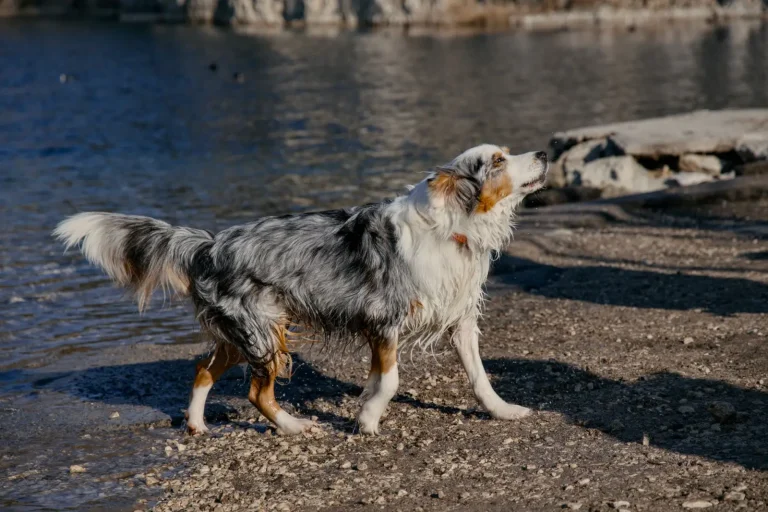


Australian Shepherds tend to get along with other dogs reasonably well, but their success in a multi-dog household depends heavily on early exposure, individual temperament, and how their herding instincts are managed day to day. I’ve worked with enough of these dogs to know that blanket statements about breed compatibility don’t hold up when you’re actually living with one in a house with other animals.
The breed’s herding heritage shows up in how they interact with other dogs. Many Aussies will naturally try to control the movement of their housemates – nipping at heels, circling, or positioning themselves to direct another dog’s behavior. This isn’t aggression in the traditional sense. It’s a deeply ingrained drive to move and manage livestock, and other dogs are simply the closest thing to livestock in their environment. A dog that’s unfamiliar with this behavior might interpret it as play or as a challenge, depending on their own temperament and confidence level.
Temperament Variation Within the Breed
Not all Australian Shepherds display herding behavior with equal intensity. Some are naturally more laid-back and social, while others are intensely focused on control and movement. I’ve seen dogs from the same litter develop very differently once they’re in different homes. The one raised with calm, older dogs from puppyhood often becomes a cooperative housemate. The one raised alone or with minimal dog exposure sometimes struggles when suddenly placed with other dogs as an adult.
Individual personality matters more than breed tendency alone. Some Aussies are genuinely social and enjoy the company of other dogs. Others are more independent and tolerate other dogs rather than actively seek their company. A few are naturally dominant or territorial, which can create friction in a multi-dog setting. These differences exist within the breed and aren’t always predictable from a puppy’s early behavior.
The Socialization Window and Later Adjustment
Puppies exposed to other dogs during their critical socialization period – roughly 3 to 14 weeks – typically develop better social skills with other canines. An Aussie that grows up around other dogs learns to read canine body language, understand play boundaries, and regulate their own intensity. This early exposure doesn’t guarantee perfect compatibility later, but it does establish a foundation.
Australian Shepherds introduced to other dogs as adults can adjust, though it’s often slower and requires more management. An adult dog arriving in a home with established dogs may initially be cautious or, conversely, overly enthusiastic. The existing dogs may see a newcomer as a disruption to their routine. I’ve found that gradual introductions – separate spaces initially, supervised interactions, clear boundaries – work better than throwing them together and hoping for the best.
Managing Herding Behavior in Practice
When an Australian Shepherd starts herding another dog, the response depends on the other dog’s tolerance and the Aussie’s intensity. Some dogs find it annoying but harmless. Others escalate defensively, especially if they’re not used to being nipped or circled. The Aussie isn’t trying to start a fight; they’re trying to do their job. But the other dog doesn’t know that.
Redirecting this behavior works better than punishing it. When you catch your Aussie fixating on another dog’s movement, directing them toward a toy, a command, or a different activity interrupts the pattern. Over time, many learn to suppress the herding impulse in the home, though it may resurface under stress or excitement. Some owners find that regular exercise and mental stimulation reduce the frequency of herding behavior, simply because the dog has fewer pent-up instincts driving the behavior.
The size and energy level of the other dog matters. An Australian Shepherd living with a similar-sized, energetic dog often does better than one paired with a small, fragile dog or a senior dog that wants peace and quiet. The compatible housemate is usually one that can hold their own in play and won’t be injured by the Aussie’s herding attempts.
Dominance and Resource Issues
Some Australian Shepherds display resource guarding – protecting food, toys, or even attention from other dogs. This isn’t universal to the breed, but it’s common enough that it’s worth watching for. A dog that guards resources can create genuine conflict in a multi-dog home, especially if the other dogs are passive or submissive.
Managing this usually means feeding dogs separately, removing high-value toys when dogs are unsupervised, and ensuring each dog has their own space where they can retreat without competition. In some cases, the guarding behavior is mild and manageable. In others, it’s significant enough that separate living spaces become necessary.
Dominance displays – standing over another dog, blocking doorways, controlling access to the owner – are something I see occasionally. These behaviors can escalate if not addressed early. They’re not always a sign of aggression, but they do indicate that the Aussie is trying to establish hierarchy, which can create tension in the household.
Energy Compatibility and Exercise
An under-exercised Australian Shepherd is often a more difficult housemate. The breed was developed to work all day, and many Aussies have high energy levels that don’t switch off just because they’re living indoors. A dog that isn’t getting adequate physical and mental stimulation may become more intense with other dogs, more reactive, and more prone to herding behavior.
Pairing an Aussie with a dog that has similar energy levels usually works better than pairing them with a low-energy breed. A high-drive Aussie and a calm, older dog can coexist, but the Aussie needs enough outlet elsewhere – through training, play, or work – that they’re not constantly trying to engage the other dog.
Australian Shepherds do well with other dogs when the conditions align: early socialization, individual temperament that leans social rather than territorial, adequate exercise, and management of herding instincts. They’re not inherently aggressive or unsociable, but they’re not automatically compatible with every dog either. The breed’s working background shapes how they interact, and recognizing that drive rather than fighting it makes for a more peaceful household.