
Australian Shepherds have a particular way of noticing other dogs. Their herding instinct and intense focus mean they tend to lock onto movement and presence in ways that many other breeds don’t. I’ve worked with dozens of these dogs over the years, and the ones that struggle most around other canines aren’t necessarily poorly trained – they’re often just wired to pay attention. The challenge isn’t really about teaching them to ignore other dogs so much as it is about redirecting that natural attentiveness into something more manageable.
The first thing I notice when someone brings an Australian Shepherd to me with reactivity issues is usually that the dog has never learned what “ignoring” actually feels like. Many owners assume that a solid sit-stay or down-stay in a quiet room will translate to indifference when another dog appears, but that’s not how these dogs process the world. An Aussie that can hold a perfect obedience position at home might still fixate intensely on a passing dog because the stimulus is novel and activating. The dog isn’t being disobedient – it’s responding to something its brain finds genuinely interesting.
Why Aussies Lock Onto Other Dogs
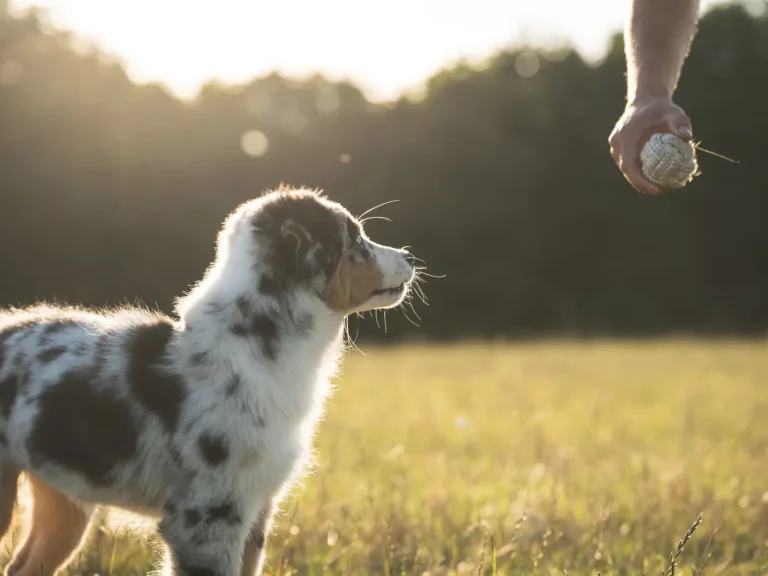
The herding breeds were developed to move and control livestock through sustained visual focus and quick decision-making. An Australian Shepherd’s brain is literally built to track movement and respond to it. When they see another dog, especially one that’s moving unpredictably or at a distance, their instinct is to assess, engage, and potentially intercept. This isn’t aggression in most cases – it’s a working drive that has no appropriate outlet in an urban environment.
What complicates this further is that many Aussies develop a kind of anticipatory anxiety around other dogs. If they’ve had a few chaotic encounters or even just inconsistent experiences, they begin to expect that seeing another dog means something is about to happen. Their body tenses, their breathing changes, and they fixate harder. Once a dog is in that state, obedience commands become much less effective because the dog is operating from a place of heightened arousal rather than calm decision-making.
Building Genuine Disinterest
The most effective work I’ve done with Australian Shepherds has involved creating situations where the dog learns that other dogs are simply part of the environment – unremarkable, predictable, and not worth the energy of intense focus. This is different from teaching compliance. A dog that sits on command while staring intently at another dog hasn’t really learned to ignore anything. The dog is just following an instruction while remaining internally activated.
What tends to work better is exposure at a distance where the Aussie can observe other dogs without feeling compelled to react. I’ll often start with a dog at a considerable distance – sometimes 50 to 100 feet away from another dog, depending on the individual’s sensitivity. The goal is to find a threshold where the Aussie notices the other dog but doesn’t escalate into fixation. At that point, the dog’s own nervous system can begin to habituate. Repetition at this level, over weeks and months, genuinely changes how the dog’s brain processes the presence of other canines.
During these exposure sessions, I’m not asking for obedience. I’m not using treats or commands. I’m simply allowing the dog to be present and calm. Sometimes I’ll walk parallel to another dog at a distance, or I’ll sit quietly while another dog is visible but far away. The Aussie learns through experience that nothing happens, the other dog isn’t a threat or a toy, and there’s no reason to maintain high alert.
The Role of Exercise and Mental Work
One pattern I see consistently is that Aussies with insufficient mental engagement tend to fixate more intensely on other dogs. These are dogs that were bred to work for hours, making independent decisions about moving livestock. When they don’t have appropriate outlets for that drive, they channel it into whatever is available – and another dog often becomes the focus. A dog that’s been given a meaningful task or puzzle to solve before an encounter with other dogs often shows noticeably less reactivity.
This doesn’t mean the dog needs to be exhausted. I’ve learned that a tired dog isn’t necessarily a calm dog, especially with herding breeds. What matters more is that the dog’s brain has been engaged in something purposeful. A 20-minute session of scent work, obedience practice, or problem-solving often settles an Aussie’s nervous system more effectively than an hour of running. The dog feels like it has done its job, and other dogs become less interesting as a result.
What Doesn’t Work Well
I’ve seen owners try to suppress reactivity through punishment or through constant redirection, and both approaches tend to backfire with this breed. An Aussie that gets corrected for looking at another dog often becomes more anxious about the presence of other dogs, which can actually increase fixation over time. The dog learns to fear the correction, not to be indifferent to the other dog.
Similarly, constantly asking for obedience commands when other dogs appear can create a pattern where the dog becomes dependent on instructions to manage its own arousal. The dog never learns to self-regulate. It learns that it needs a handler to tell it what to do in the presence of other dogs. This can work in controlled settings, but it’s fragile and doesn’t transfer well to real-world situations where you might be distracted or the other dog appears suddenly.
I’ve also noticed that Aussies respond poorly to group training classes designed to “socialize” them with other dogs if the class environment is chaotic or if the dogs are allowed to interact freely. These dogs often become more reactive, not less, because they’re being asked to manage high-level stimulation without clear boundaries. A calm, structured exposure to other dogs at a distance works far better than a playgroup environment.
Practical Consistency Over Time
The dogs I’ve worked with that have genuinely learned to be indifferent to other dogs are the ones whose owners committed to consistent, low-key exposure over several months. This isn’t glamorous work. It involves a lot of quiet walks, a lot of sitting at a distance from other dogs, and a lot of patience with incremental progress. But it does work.
What I tell owners is that their Aussie’s reactivity to other dogs isn’t a permanent trait. It’s a learned response pattern, and it can be unlearned. The process requires understanding what the dog’s brain is actually doing – not assuming that obedience will solve the problem – and then creating enough repetition and calm exposure that the dog’s nervous system recalibrates. An Australian Shepherd that has been given the opportunity to learn that other dogs are simply background noise in the environment will eventually stop treating them as a priority. It takes time, but it’s a more durable solution than any amount of command training alone.