
Australian Shepherds come to agility with a natural advantage. They have the drive, the athleticism, and the intelligence to pick up obstacles quickly. But I’ve watched plenty of owners rush into equipment before their dog was genuinely ready, and the pattern is always the same: the dog gets frustrated, loses confidence, or develops a habit that takes weeks to undo. Starting right matters more than starting fast.
The first thing I notice when working with a young Aussie is that they often want to work before their body is ready. Their minds are sharp enough to understand what you’re asking by six or seven months old, but their joints and ligaments are still developing. This is the critical mistake people make. They see their pup’s intelligence and enthusiasm and assume readiness. A dog that can learn a command isn’t the same as a dog whose growth plates have closed enough to handle the impact of jumping or weaving at speed.
I typically wait until a dog is at least 12 to 14 months old before introducing any jumping or repetitive directional work. For larger Australian Shepherds, 18 months is safer. This isn’t arbitrary. It’s based on what I’ve observed with dogs who started too early: lameness that appears months later, reluctance to jump, or a permanent change in how they move. The cost of waiting a few months is nothing compared to managing a chronic issue.
What Actually Gets Used Early
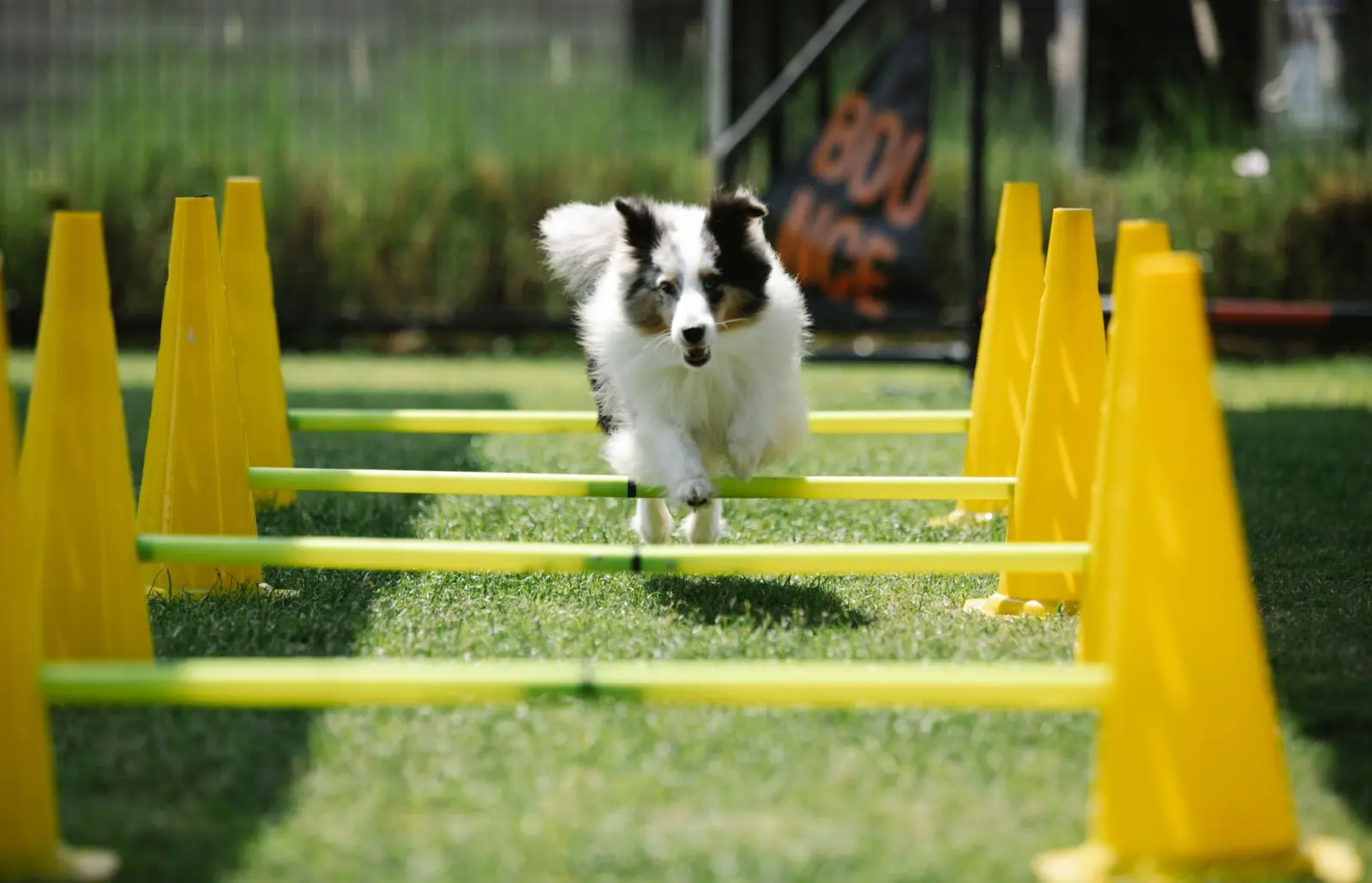
When I do start, the equipment that makes sense is the stuff that builds foundation without impact. A low jump pole – and I mean genuinely low, just a few inches off the ground – teaches a dog the concept of jumping without stress. The dog learns that there’s an obstacle, learns to clear it, and learns the rhythm of approach and takeoff. None of this requires height. Most people set jumps too high too soon, which creates the opposite problem: the dog learns to jump inefficiently or develops a habit of refusing.
Weave poles are another early tool, but they need to be set wide at first. I’ve seen handlers place weave poles at regulation spacing right away, which turns the exercise into a frustration rather than a learning opportunity. When poles are three or four feet apart instead of two, a dog naturally learns the weaving pattern without getting tangled or discouraged. Tightening them comes later, once the dog understands the concept and has the coordination to execute it smoothly.
Pause tables are genuinely useful early on. They teach a dog to jump onto an obstacle and hold position. There’s no impact stress, the dog learns impulse control, and it builds confidence. I start with a low platform – sometimes just a sturdy board on the ground – and let the dog explore it at their own pace. Many Aussies will jump on it immediately because they like being elevated. The pause comes naturally once they understand they’re supposed to stop there.
The Equipment That Reveals Problems
Tunnels are where I often see the first sign of whether a dog is truly ready for agility. A tunnel requires a dog to commit to forward motion through an enclosed space without seeing the exit. Young dogs sometimes panic or refuse. This isn’t usually a training problem; it’s a maturity problem. A dog that’s not ready will tell you clearly. Some handlers push through this, which creates genuine anxiety. I’ve found it’s better to introduce tunnels when a dog is older and more confident overall.
A-frames and dog walks are equipment I don’t typically use with dogs under 18 months, and even then, only if they’ve shown consistent comfort with lower obstacles. These require balance, coordination, and the ability to manage height and descent. I’ve watched dogs slip on the descent of a dog walk because they weren’t physically coordinated enough to manage it, and that one bad experience can make them hesitant for months. The equipment itself isn’t the problem; the timing is.
What I Actually Recommend Starting With
If I’m setting up a beginner program for an Australian Shepherd, I focus on three pieces of equipment for the first several months. A set of weave poles spaced wide. A low jump pole or two. A pause table or platform. That’s genuinely enough to teach the fundamentals: directional changes, jumping, and impulse control. Everything else can wait.
The jump poles should be adjustable. I use PVC pipe set in jump standards that allow height adjustment. Starting at ankle height and moving up gradually over weeks teaches the dog to jump efficiently without asking them to clear obstacles that are too high. Australian Shepherds are athletic, but they’re not huge dogs. A 16-inch jump is substantial for them, and many don’t need to jump higher than 20 inches in standard agility anyway.
Weave pole spacing matters more than the poles themselves. I’ve used everything from PVC to metal poles, and the dog doesn’t care. What matters is that they’re set far enough apart that the dog can navigate them without getting tangled. Six feet apart is a reasonable starting point. Once the dog is weaving smoothly and confidently, I gradually decrease the spacing by six inches at a time until they reach regulation distance.
Building Consistency Before Complexity
What I’ve learned over years of working with Aussies is that they progress faster when you don’t add new obstacles constantly. A dog that runs the same three pieces of equipment reliably for four or five weeks learns more than a dog that encounters something new every session. The repetition builds muscle memory and confidence. It also gives you time to notice what’s actually happening – whether the dog is genuinely understanding the task or just following habit.
An Australian Shepherd’s intelligence can work against them here. They learn patterns quickly, which means they can develop bad habits just as fast. If a dog learns to cut a corner on weave poles because the spacing is too wide and they can physically skip a pole, they’ll keep doing that even after you tighten the spacing. Starting with correct fundamentals, even if progress feels slow, prevents months of retraining later.
The handler’s role in early agility is observation, not correction. I watch how the dog approaches each obstacle. Does the dog hesitate? Do they take off too early or too late on jumps? Are they using their back legs effectively? These observations tell me whether the dog is ready to progress or whether we need more time at the current level. Most handlers want to move forward; most dogs benefit from staying put a bit longer.
Australian Shepherds are built for this work, and they genuinely enjoy it when it’s introduced thoughtfully. The dogs that thrive in agility are the ones who started slowly, built confidence gradually, and never experienced failure because they were asked to do something they weren’t ready for. That’s not a limitation of the breed. That’s just how learning works.